


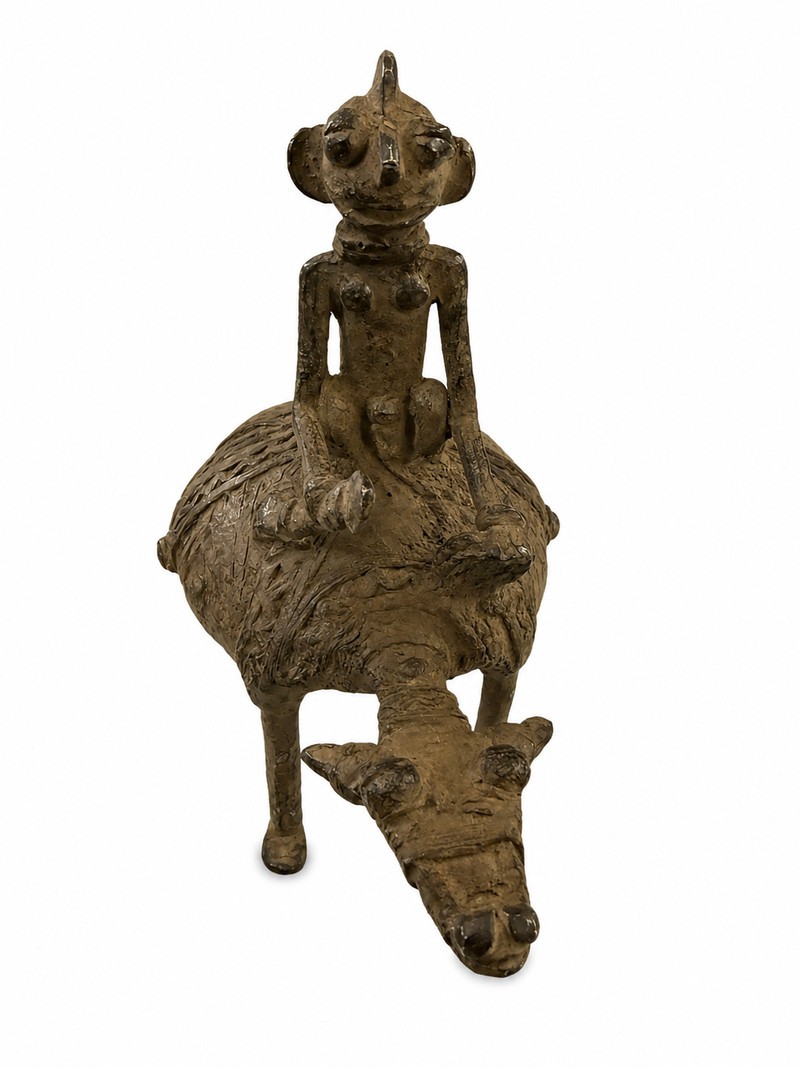
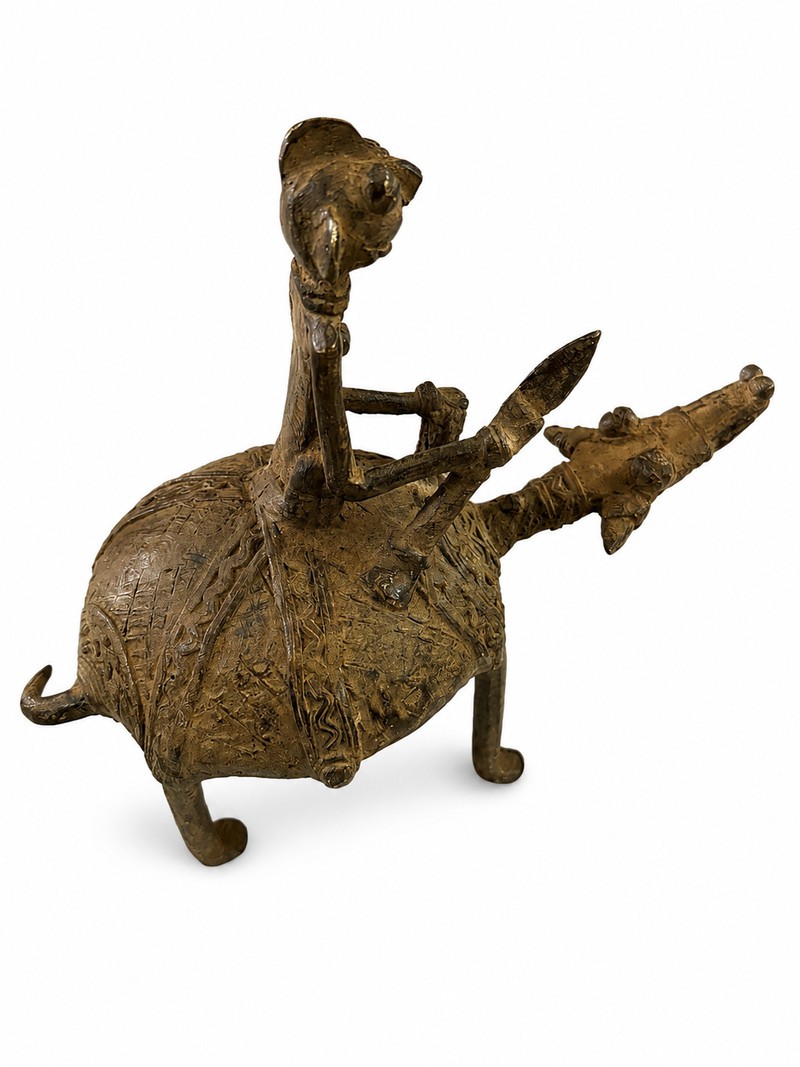
Dogon horseman
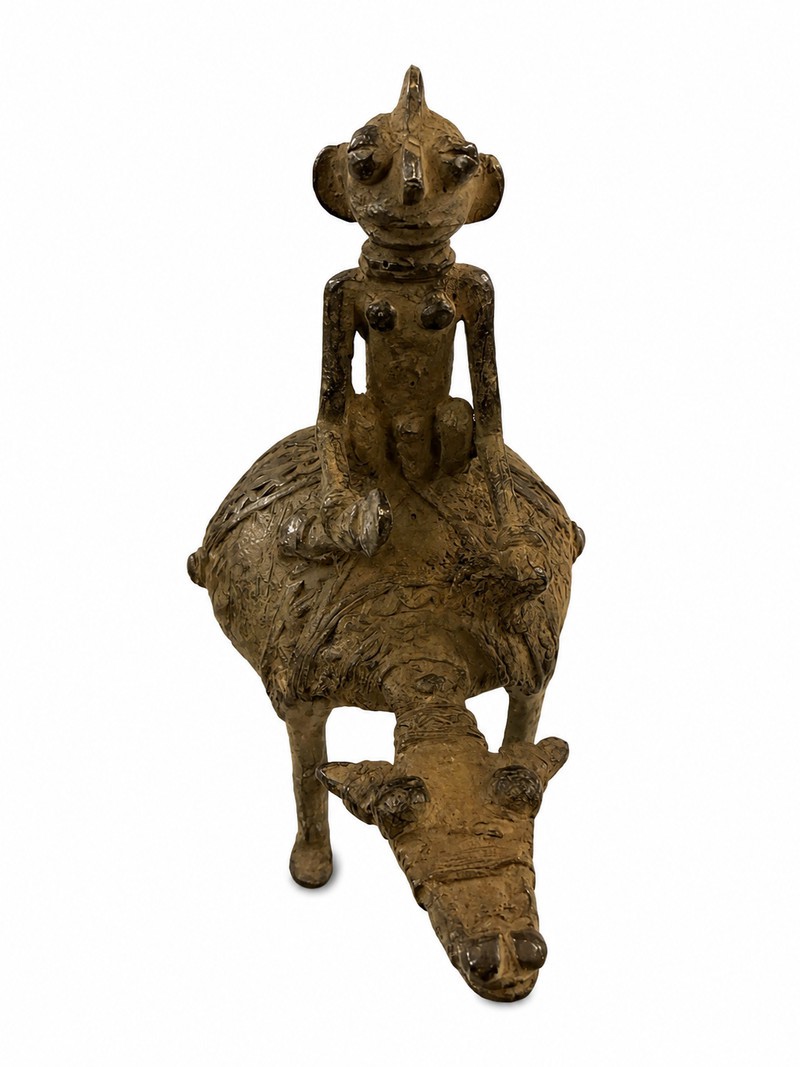
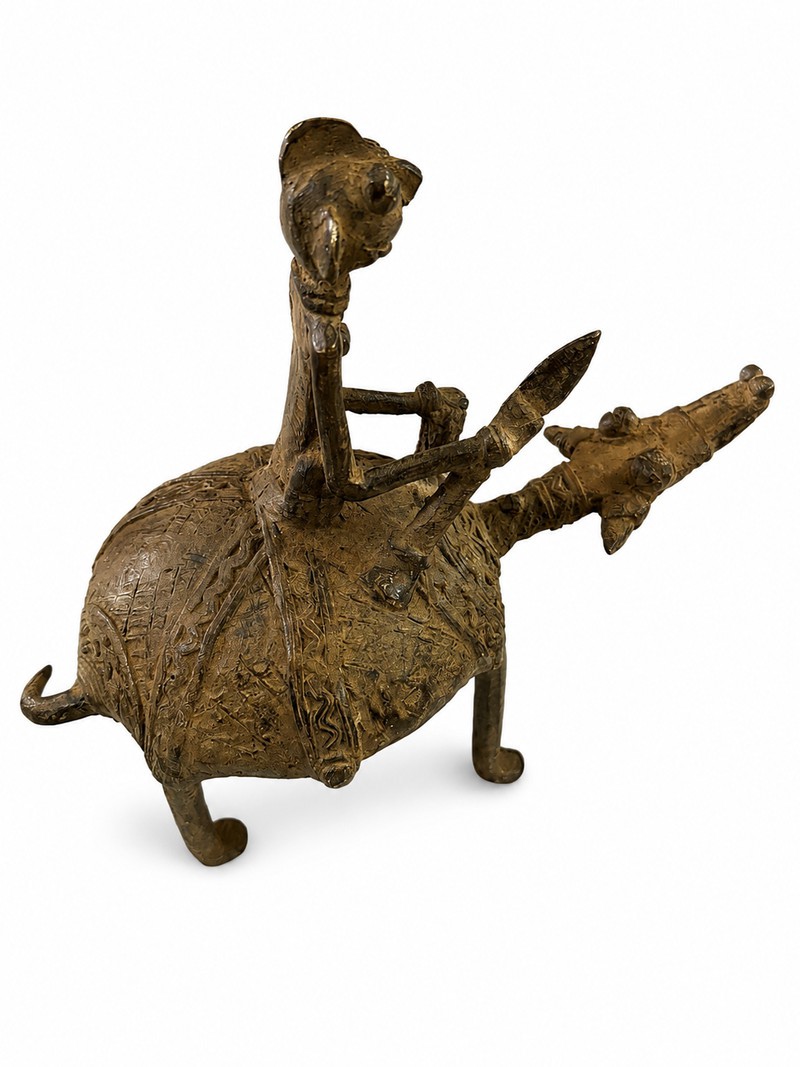
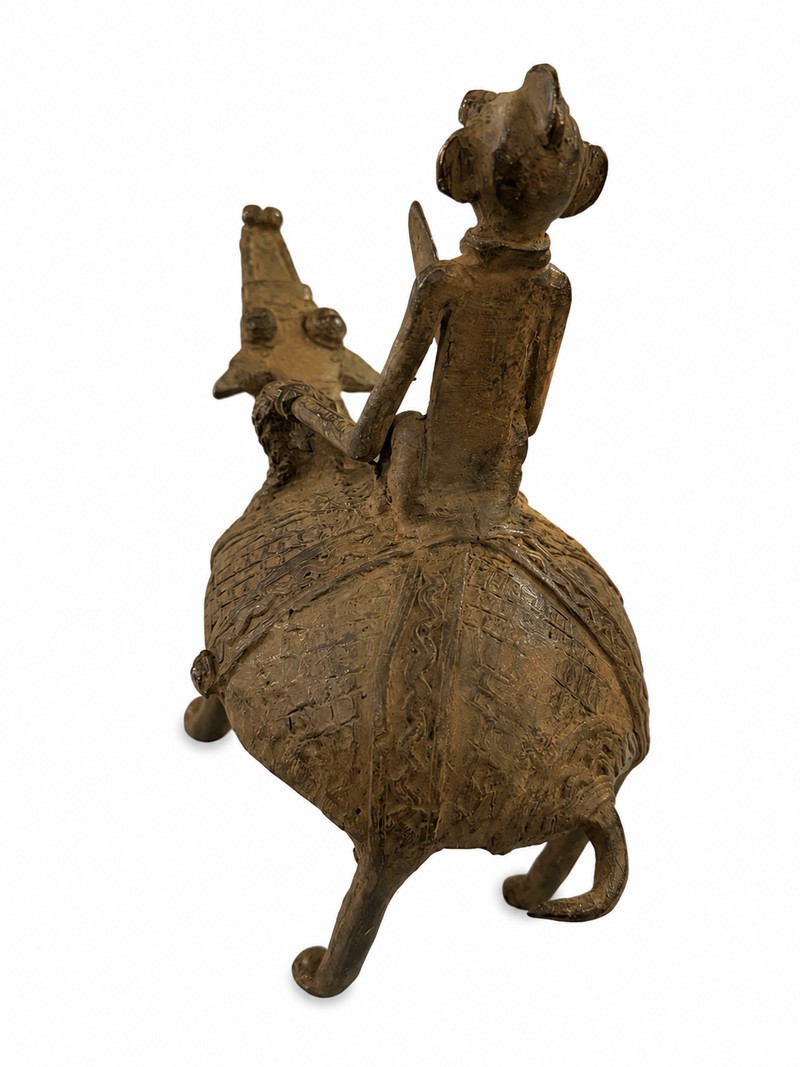
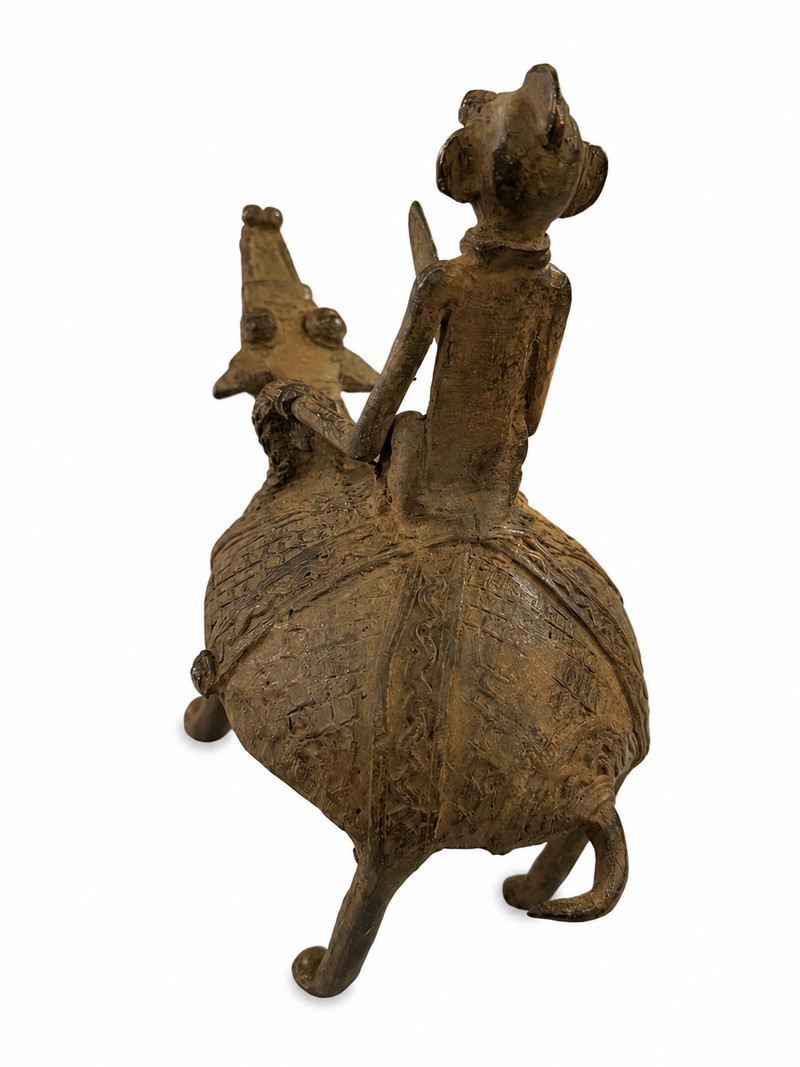
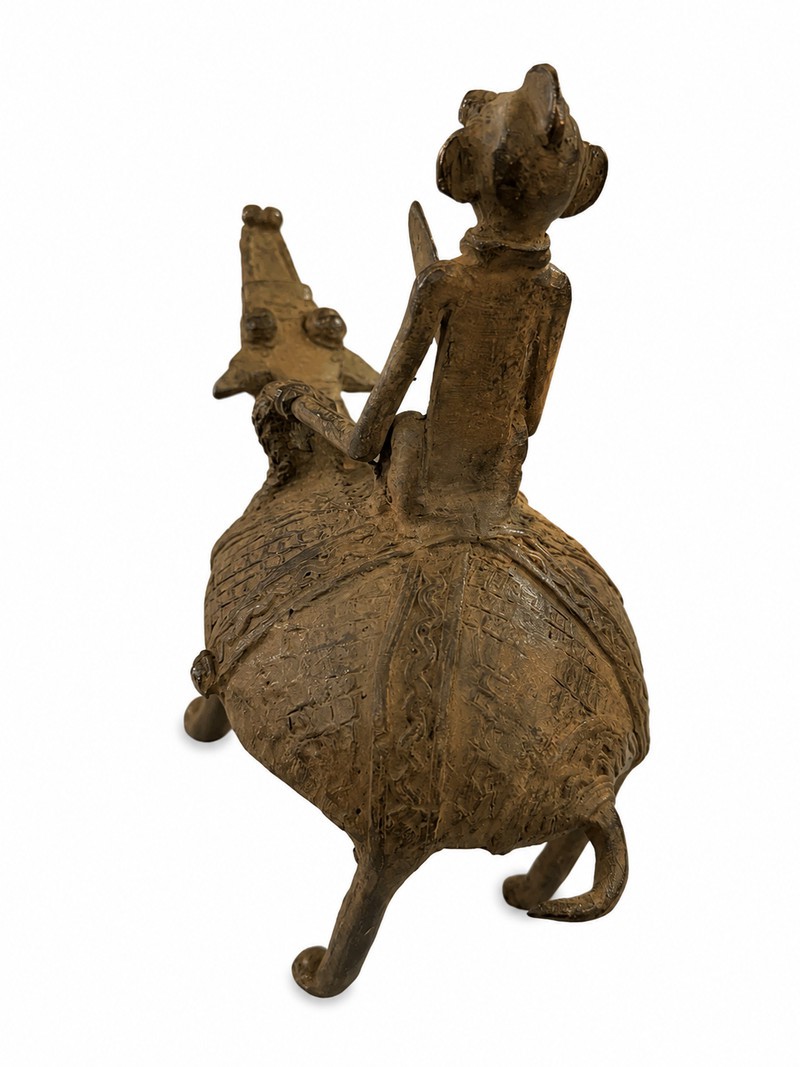
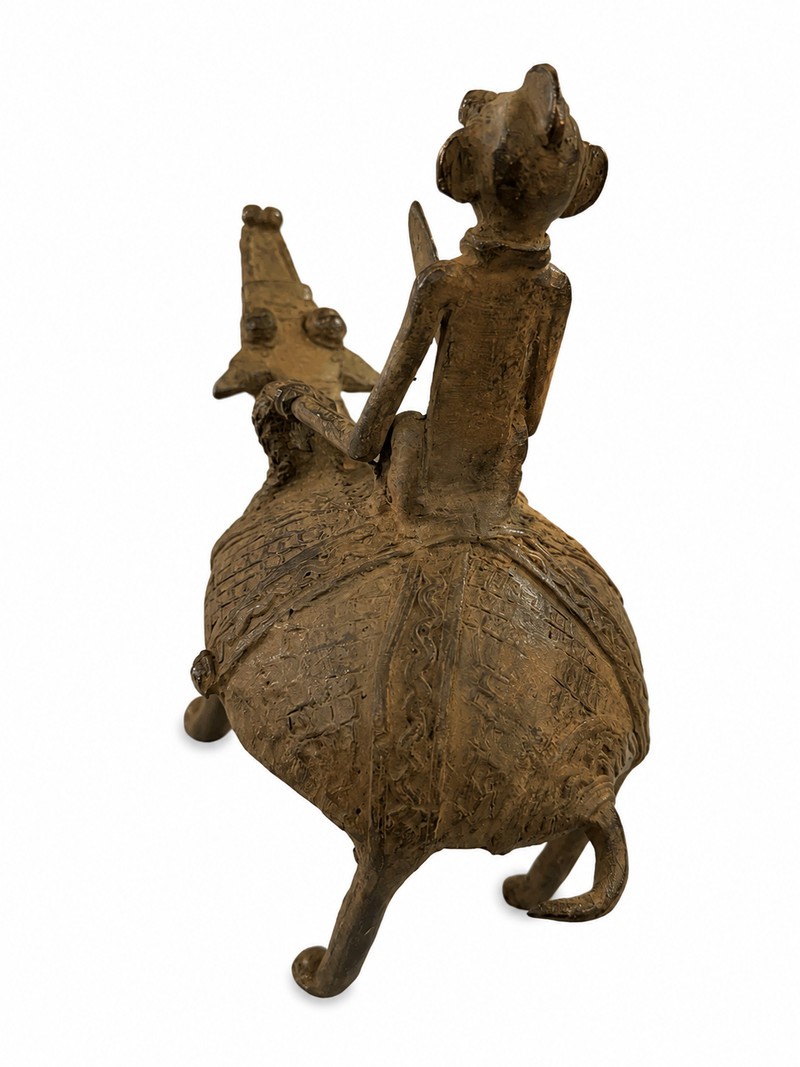
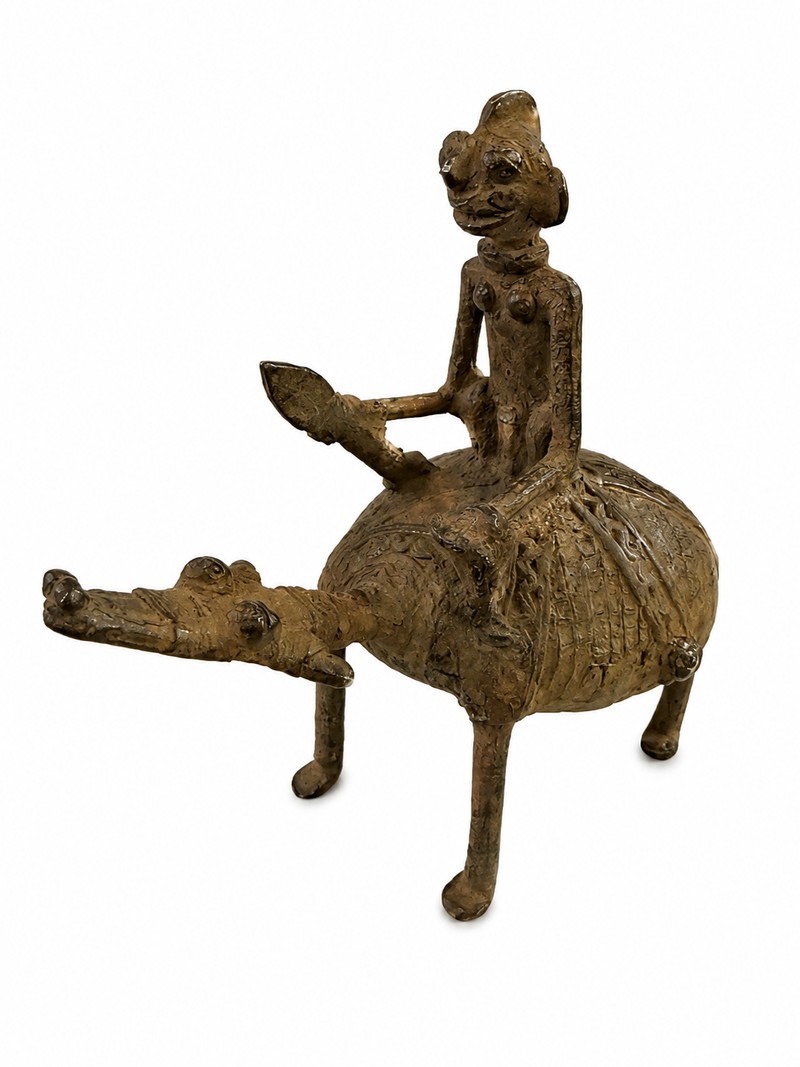
This piece is a patinated bronze tribal statuette depicting a figure perched on a massive mount, characteristic of traditional West African art (often associated with Dogon bronzes from Mali or Sahelian cultures). Origin and style: Attributed to West African statuary, this representation presents a marked stylistic contrast between the slender figure and the robust animal. Technique: Made of copper alloy (bronze or brass) using the ancient lost-wax casting technique, it features a brown patina and chiseled details. Symbolism: In Sahelian culture, figures of horsemen or figures on mounts symbolize prestige, spiritual protection, or stories related to ancestors and founding myths. Dogon Bronzes (Mali): Refinement and Stylization. Linear and slender aesthetic: The figures are characterized by very elongated, slender, and geometric limbs (like the statuette studied previously). Raw and textured appearance: The surfaces often retain a rough grain, visible casting marks, and an ochre or earthy patina that testifies to a strong connection with earth worship and family altars. Cosmological symbolism: The representations highlight mythical entities (such as the first primordial being Nommo or the Hogon) on stylized creatures (horses or buffaloes) with simplified forms.
Translated automatically
View original
This piece is a patinated bronze tribal statuette depicting a figure perched on a massive mount, characteristic of traditional West African art (often associated with Dogon bronzes from Mali or Sahelian cultures). Origin and style: Attributed to West African statuary, this representation presents a marked stylistic contrast between the slender figure and the robust animal. Technique: Made of copper alloy (bronze or brass) using the ancient lost-wax casting technique, it features a brown patina and chiseled details. Symbolism: In Sahelian culture, figures of horsemen or figures on mounts symbolize prestige, spiritual protection, or stories related to ancestors and founding myths. Dogon Bronzes (Mali): Refinement and Stylization. Linear and slender aesthetic: The figures are characterized by very elongated, slender, and geometric limbs (like the statuette studied previously). Raw and textured appearance: The surfaces often retain a rough grain, visible casting marks, and an ochre or earthy patina that testifies to a strong connection with earth worship and family altars. Cosmological symbolism: The representations highlight mythical entities (such as the first primordial being Nommo or the Hogon) on stylized creatures (horses or buffaloes) with simplified forms.
Cette pièce est une statuette tribale en bronze patinée représentant un personnage juché sur une monture massive, caractéristique de l'art traditionnel d'Afrique de l'Ouest (souvent associé aux bronzes Dogon du Mali ou des cultures sahéliennes).
Origine et style : Attribuée à l'art statuaire d'Afrique de l'Ouest, cette représentation met en scène un contraste stylistique marqué entre le personnage aux membres filiformes et l'animal robuste.
Technique : Fabriquée en alliage de cuivre (bronze ou laiton) selon la technique ancestrale de la fonte à la cire perdue, présentant une patine de couleur brune et des détails ciselés.
Symbolique : Dans la culture sahélienne, les figures de cavaliers ou de personnages sur des montures symbolisent le prestige, la protection spirituelle, ou les récits liés aux ancêtres et aux mythes fondateurs.
Les Bronzes Dogon (Mali) : L'Épure et la Stylisation
Esthétique linéaire et filiforme : Les personnages se caractérisent par des membres très allongés, fins et géométriques (comme la statuette étudiée précédemment).
Aspect brut et texturé : Les surfaces conservent souvent un grain rugueux, des traces de coulée apparentes et une patine ocrée ou terreuse qui témoigne d'un lien fort avec le culte de la terre et des autels familiaux.
Symbolisme cosmologique : Les représentations mettent en valeur des entités mythiques (comme le premier être primordial Nommo ou le Hogon) sur des créatures stylisées (chevaux ou buffles) aux formes simplifiées.
More from tendancethnik
Visit the shop


You May Also Like
Explore More


Similar searches
At Africa Creates, we do not believe in the myth of predefined sizes. Each body is different and deserves an outfit just as unique. Therefore, to use this guide, we recommend using your measurements in inches (as explained below) rather than the "4 to 22" sizes.
From there you can select the corresponding international size for your order, and each seller will then be able to make sure to send the PERFECT fit for YOU!
How to measure ?
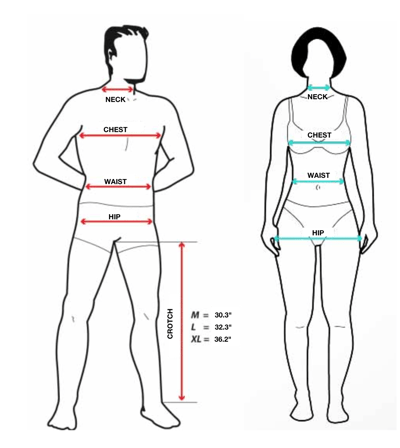
Collar size
Measure around the neck at the neck.
Chest size
Measure around your bust where it is wider by placing the tape measure under the arms and over the shoulder blades.
Waist size
Measure in the hollow of the waist.
Hip size
Keep your feet together and measure the widest part.
Crotch tower
Measure the top of the crotch up to the ankle bone.
Woman - Tops and dresses
| Int | Chest (in) | Waist (in) | Hip (in) | EU | UK | US |
|---|---|---|---|---|---|---|
| XXS | 30.7" - 32.3" | 22.8" - 24.4" | 33.1" - 34.6" | 32 | 4 | 0 |
| XS | 32.3" - 33.9" | 24.4" - 26" | 34.6" - 36.2" | 34 | 6 | 2 |
| S | 33.9" - 35.4" | 26" - 27.6" | 36.2" - 37.8" | 36 | 8 | 4 |
| M | 35.4" - 37" | 27.6" - 29.1" | 37.8" - 39.4" | 38 | 10 | 6 |
| L | 37" - 38.6" | 29.1" - 30.7" | 39.4" - 40.9" | 40 | 12 | 8 |
| XL | 38.6" - 40.2" | 30.7" - 32.3" | 40.9" - 42.5" | 42 | 14 | 10 |
| XXL | 40.2" - 41.7" | 32.3" - 33.9" | 42.5" - 44.1" | 44 | 16 | 12 |
| 3XL | 41.7" - 43.3" | 33.9" - 35.4" | 44.1" - 45.7" | 46 | 18 | 14 |
| 4XL | 43.3" - 45.7" | 35.4" - 38.6" | 45.7" - 48" | 48 | 20 | 16 |
| 5XL | 45.7" - 48" | 38.6" - 41.7" | 48" - 50.4" | 50 | 22 | 18 |
| 6XL | 48" - 50.4" | 41.7" - 44.9" | 50.4" - 52.8" | 52 | 24 | 20 |
| 7XL | 50.4" - 52.8" | 44.9" - 48" | 52.8" - 55.1" | 54 | 26 | 22 |
Woman - Pants, Skirts and Shorts
| Int | Waist (in) | EU | UK | US |
|---|---|---|---|---|
| XXS | 22.8" - 24.4" | 32 | 4 | 0 |
| XS | 24.4" - 26" | 34 | 6 | 2 |
| S | 26" - 27.6" | 36 | 8 | 4 |
| M | 27.6" - 29.1" | 38 | 10 | 6 |
| L | 29.1" - 30.7" | 40 | 12 | 8 |
| XL | 30.7" - 32.3" | 42 | 14 | 10 |
| XXL | 32.3" - 33.9" | 44 | 16 | 12 |
| 3XL | 33.9" - 35.4" | 46 | 18 | 14 |
| 4XL | 35.4" - 38.6" | 48 | 20 | 16 |
| 5XL | 38.6" - 41.7" | 50 | 22 | 18 |
| 6XL | 41.7" - 44.9" | 52 | 24 | 20 |
| 7XL | 44.9" - 48" | 54 | 26 | 22 |
Woman - Swimwear
| Int | Chest (in) | Waist (in) | Hip (in) | EU | UK | US |
|---|---|---|---|---|---|---|
| XXS | 30.7" | 23.6" | 33.1" | 32 | 4 | 0 |
| XS | 31.5" | 24.4" | 33.9" | 34 | 6 | 2 |
| S | 32.7" | 25.6" | 35" | 36 | 8 | 4 |
| M | 34.6" | 27.6" | 37" | 38 | 10 | 6 |
| L | 36.6" | 29.5" | 39" | 40 | 12 | 8 |
| XL | 38.6" | 31.5" | 40.9" | 42 | 14 | 10 |
| XXL | 40.5" | 33.5" | 42.9" | 44 | 16 | 12 |
| 3XL | 43.3" | 36.2" | 45.7" | 46 | 18 | 14 |
Woman - Bra
| Below the breasts (in) | Above the breasts (in) | EU | UK | US |
|---|---|---|---|---|
| 22.8" - 24.4" | 27.6" - 28.3" | 75 (AA) | ||
| 22.8" - 24.4" | 28.3" - 29.1" | 75 (A) | 28A | 28A |
| 22.8" - 24.4" | 29.1" - 29.9" | 75 (B) | 28B | 28B |
| 22.8" - 24.4" | 29.9" - 30.7" | 75 (C) | 28C | 28C |
| 22.8" - 24.4" | 30.7" - 31.5" | 75 (D) | 28D | 28D |
| 22.8" - 24.4" | 31.5" - 32.3" | 75 (E) | 28DD | 28DD |
| 22.8" - 24.4" | 32.3" - 33.1" | 75 (F) | 28E | 28DDD |
| 22.8" - 24.4" | 33" - 33.9" | 75 (G) | 28F | 28G |
| 22.8" - 24.4" | 33.9" - 34.6" | 75 (H) | 28FF | 28H |
| 24.4" - 26.4" | 30.3" - 31.1" | 80 (A) | 30A | 30A |
| 24.4" - 26.4" | 31.1" - 31.9" | 80 (B) | 30B | 30B |
| 24.4" - 26.4" | 31.9" - 32.7" | 80 (C) | 30C | 30C |
| 24.4" - 26.4" | 32.7" - 33.5" | 80 (D) | 30D | 30D |
| 24.4" - 26.4" | 33.5" - 34.2" | 80 (E) | 30DD | 30DD |
| 24.4" - 26.4" | 34.2" - 35" | 80 (F) | 30E | 30DDD |
| 24.4" - 26.4" | 35" - 35.8" | 80 (G) | 30F | 30G |
| 24.4" - 26.4" | 35.8" - 36.6" | 80 (H) | 30FF | 30H |
| 26.4" - 28.3" | 32.3" - 33.1" | 85 (A) | 32A | 32A |
| 26.4" - 28.3" | 33.1" - 33.9" | 85 (B) | 32B | 32B |
| 26.4" - 28.3" | 33.9" - 34.6" | 85 (C) | 32C | 32C |
| 26.4" - 28.3" | 34.6" - 35.4" | 85 (D) | 32D | 32D |
| 26.4" - 28.3" | 35.4" - 36.2" | 85 (E) | 32DD | 32DD |
| 26.4" - 28.3" | 36.2" - 37" | 85 (F) | 32E | 32DDD |
| 26.4" - 28.3" | 37" - 37.8" | 85 (G) | 32F | 32G |
| 26.4" - 28.3" | 37.8" - 38.6" | 85 (H) | 32FF | 32H |
| 28.3" - 30.3" | 34.2" - 35" | 90 (A) | 34A | 34A |
| 28.3" - 30.3" | 35" - 35.8" | 90 (B) | 34B | 34B |
| 28.3" - 30.3" | 35.8" - 36.6" | 90 (C) | 34C | 34C |
| 28.3" - 30.3" | 36.6" - 37.4" | 90 (D) | 34D | 34D |
| 28.3" - 30.3" | 37.4" - 38.2" | 90 (E) | 34DD | 34DD |
| 28.3" - 30.3" | 38.2" - 39" | 90 (F) | 34E | 34DDD |
| 28.3" - 30.3" | 39" - 39.8" | 90 (G) | 34F | 34G |
| 28.3" - 30.3" | 39.8" - 40.5" | 90 (H) | 34FF | 34H |
| 30.3" - 32.3" | 36.2" - 37" | 95 (A) | 36A | 36A |
| 30.3" - 32.3" | 37" - 37.8" | 95 (B) | 36B | 36B |
| 30.3" - 32.3" | 37.8" - 38.6" | 95 (C) | 36C | 36C |
| 30.3" - 32.3" | 38.6" - 39.4" | 95 (D) | 36D | 36D |
| 30.3" - 32.3" | 39.4" - 40.2" | 95 (E) | 36DD | 36DD |
| 30.3" - 32.3" | 40.2" - 40.9" | 95 (F) | 36E | 36DDD |
| 30.3" - 32.3" | 40.9" - 41.7" | 95 (G) | 36F | 36G |
| 30.3" - 32.3" | 41.7" - 42.5" | 95 (H) | 36FF | 36H |
| 100 (AA) | ||||
| 32.3" - 34.2" | 38.2" - 39" | 100 (A) | 38A | 38A |
| 32.3" - 34.2" | 39" - 39.8" | 100 (B) | 38B | 38B |
| 32.3" - 34.2" | 39.8" - 40.5" | 100 (C) | 38C | 38C |
| 32.3" - 34.2" | 40.5" - 41.3" | 100 (D) | 38D | 38D |
| 32.3" - 34.2" | 41.3" - 42.1" | 100 (E) | 38DD | 38DD |
| 32.3" - 34.2" | 42.1" - 42.9" | 100 (F) | 38E | 38DDD |
| 32.3" - 34.2" | 42.9" - 43.7" | 100 (G) | 38F | 38G |
| 32.3" - 34.2" | 43.7" - 44.5" | 100 (H) | 38FF | 38H |
| 34.2" - 36.2" | 40.2" - 40.9" | 105 (A) | 40A | 40A |
| 34.2" - 36.2" | 40.9" - 41.7" | 105 (B) | 40B | 40B |
| 34.2" - 36.2" | 41.7" - 42.5" | 105 (C) | 40C | 40C |
| 34.2" - 36.2" | 42.5" - 43.3" | 105 (D) | 40D | 40D |
| 34.2" - 36.2" | 43.3" - 44.1" | 105 (E) | 40DD | 40DD |
| 34.2" - 36.2" | 44.1" - 44.9" | 105 (F) | 40E | 40DDD |
| 34.2" - 36.2" | 44.9" - 45.7" | 105 (G) | 40F | 40G |
| 34.2" - 36.2" | 45.7" - 46.5" | 105 (H) | 40FF | 40H |
| 36.2" - 38.2" | 42.1" - 42.9" | 110 (A) | 42A | 42A |
| 36.2" - 38.2" | 42.9" - 43.7" | 110 (B) | 42B | 42B |
| 36.2" - 38.2" | 43.7" - 44.5" | 110 (C) | 42C | 42C |
| 36.2" - 38.2" | 44.5" - 45.3" | 110 (D) | 42D | 42D |
| 36.2" - 38.2" | 45.3" - 46.1" | 110 (E) | 42DD | 42DD |
| 36.2" - 38.2" | 46.1" - 46.8" | 110 (F) | 42E | 42DDD |
| 36.2" - 38.2" | 46.8" - 47.6" | 110 (G) | 42F | 42G |
| 36.2" - 38.2" | 47.6" - 48.4" | 110 (H) | 42FF | 42H |
| 38.2" - 40.2" | 44.1" - 44.9" | 115 (A) | 44A | 44A |
| 38.2" - 40.2" | 44.9" - 45.7" | 115 (B) | 44B | 44B |
| 38.2" - 40.2" | 45.7" - 46.5" | 115 (C) | 44C | 44C |
| 38.2" - 40.2" | 46.5" - 47.2" | 115 (D) | 44D | 44D |
| 38.2" - 40.2" | 47.2" - 48" | 115 (E) | 44DD | 44DD |
| 38.2" - 40.2" | 48" - 48.8" | 115 (F) | 44E | 44DDD |
| 38.2" - 40.2" | 48.8" - 49.6" | 115 (G) | 44F | 44G |
| 38.2" - 40.2" | 49.6" - 50.4" | 115 (H) | 44FF | 44H |
Man - Shirts
| Int | Chest (in) | Neckband (in) |
|---|---|---|
| XXS | 32"-34" | 14" |
| XS | 34"-36" | 14.5" |
| S | 36"-38" | 15" |
| M | 38"-40" | 16" |
| L | 40"-42" | 17" |
| XL | 42"-44" | 17.5" |
| XXL | 44"-46" | 18" |
| 3XL | 46"-48" | 18.5" |
Man - T-shirts, polos, sweatshirts and jumpers
| Int | Chest (in) |
|---|---|
| XXS | 32"-34" |
| XS | 34"-36" |
| S | 36"-38" |
| M | 38"-40" |
| L | 40"-42" |
| XL | 42"-44" |
| XXL | 44"-46" |
| 3XL | 46"-48" |
Man - Jackets, parkas and coats
| Int | Chest (in) |
|---|---|
| XXS | 32"-34" |
| XS | 34"-36" |
| S | 36"-38" |
| M | 38"-40" |
| L | 40"-42" |
| XL | 42"-44" |
| XXL | 44"-46" |
| 3XL | 46"-48" |
Man - Pants and shorts
| Int | Waist (in) | Height (in) | Crotch (in) |
|---|---|---|---|
| XXS | 26"-28" | Short | 30" |
| XS | 28"-30" | Standard | 32" |
| S | 30"-32" | Long | 34" |
| M | 32"-34" | ||
| L | 34"-36" | ||
| XL | 36"-38" | ||
| XXL | 38"-40" | ||
| 3XL | 40"-42" | ||
| 4XL | 42"-44" | ||
| 5XL | 44"-46" | ||
| 6XL | 46"-48" |
Kid - Baby
| Age | Weight (kg) | Height (in) |
|---|---|---|
| Birth | 3,3 | 19.7" |
| 1 month | 4 | 21.3" |
| 3 months | 5 - 6 | 23.6" |
| 6 months | 7 - 8 | 26.4" |
| 9 months | 8 - 9 | 27.9" |
| 12 months | 9 - 10 | 29.1" |
| 18 months | 11 | 31.9" |
| 24 months | 12 | 33.9" |
| 36 months | 14 | 37" |
Kid - Girl
| Age | Height (in) | Chest (in) | Waist (in) | Hip (in) |
|---|---|---|---|---|
| 2 years | 32.7" - 34.6" | 20.5" | 18.9" | 22" |
| 3 years | 34.7" - 37.8" | 21.3" | 19.7" | 22.8" |
| 4 years | 37.8" - 40.9" | 22" | 20.5" | 23.6" |
| 5 years | 40.9" - 43.3" | 22.8" | 20.9" | 24.4" |
| 6 years | 43.3" - 45.7" | 23.6" | 21.3" | 26" |
| 7 years | 45.7" - 48" | 24.4" | 21.6" | 26.8" |
| 8 years | 48" - 50.4" | 25.2" | 22" | 27.6" |
| 9 years | 50.4" - 52.8" | 26.4" | 22.4" | 28.7" |
| 10 years | 52.8" - 55.1" | 27.6" | 23.2" | 29.9" |
| 12 years | 55.1" - 59.8" | 30.7" | 24.4" | 33.1" |
| 14 years | 59.8" - 62.2" | 32.3" | 25.2" | 34.6" |
| 16 years | 62.2" - 64.6" | 33.9" | 26" | 36.2" |
Kid - Boy
| Age | Height (in) | Chest (in) | Waist (in) | Hip (in) |
|---|---|---|---|---|
| 2 years | 32.7" - 34.6" | 20.5" | 18.9" | 22" |
| 3 years | 34.6" - 37.8" | 21.3" | 19.7" | 22.8" |
| 4 years | 37.8" - 40.9" | 22" | 20.5" | 23.6" |
| 5 years | 40.9" - 43.3" | 22.8" | 20.9" | 24.4" |
| 6 years | 43.3" - 45.7" | 23.6" | 21.3" | 24.4" |
| 7 years | 45.7" - 48" | 24.4" | 21.6" | 25.2" |
| 8 years | 48" - 50.4" | 25.2" | 22" | 26" |
| 9 years | 50.4" - 52.8" | 26.4" | 22.4" | 27.2" |
| 10 years | 52.8" - 55.1" | 26.8" | 23.2" | 28.3" |
| 12 years | 55.1" - 59.8" | 29.5" | 26" | 30.7" |
| 14 years | 59.8" - 64.6" | 32.3" | 27.6" | 33.9" |
| 16 years | 64.6" - 69.3" | 35" | 29.1" | 36.2" |
Kids - Shoes
| EU | UK | US | in |
|---|---|---|---|
| 16 | 0.5 | 1 | 3.5" |
| 17 | 1 | 1.5 | 3.6" |
| 18 | 2 | 3 | 4" |
| 19 | 3 | 4 | 4.3" |
| 20 | 4 | 5 | 4.6" |
| 21 | 4.5 | 5.5 | 5" |
| 22 | 5 | 6 | 5.2" |
| 23 | 6 | 7 | 5.5" |
| 24 | 7 | 8 | 5.8" |
| 25 | 8 | 9 | 6.1" |
| 26 | 8.5 | 9.5 | 6.3" |
| 27 | 9 | 10 | 6.5" |
| 28 | 10 | 11 | 6.8" |
| 29 | 10.5 | 11.5 | 7" |
| 30 | 11 | 12 | 7.2" |
| 31 | 12 | 13 | 7.5" |
| 32 | 13 | Big Kid 1 | 7.7" |
| 33 | 13.5 | Big Kid 1,5 | 8" |
Woman - Shoes
| EU | UK | US | in |
|---|---|---|---|
| 34 | 2 | 4 | 8.2" |
| 35 | 2.5 | 4.5 | 8.3" |
| 35.5 | 3 | 5 | 8.5" |
| 36 | 3.5 | 5.5 | 8.8" |
| 36.5 | 4 | 6 | 8.9" |
| 37 | 4.5 | 6.5 | 9.1" |
| 37.5 | 5 | 7 | 9.3" |
| 38 | 5.5 | 7.5 | 9.4" |
| 38.5 | 6 | 8 | 9.5" |
| 39 | 6.5 | 8.5 | 9.7" |
| 39.5 | 7 | 9 | 9.9" |
| 40 | 7.5 | 9.5 | 10" |
| 40.5 | 8 | 10 | 10.2" |
| 41 | 8.5 | 10.5 | 10.3" |
| 41.5 | 9 | 11 | 10.5" |
| 42 | 9.5 | 11.5 | 10.7" |
| 42.5 | 10 | 12 | 10.9" |
Man - Shoes
| EU | UK | US | in |
|---|---|---|---|
| 38.5 | 5 | 5.5 | 9" |
| 39 | 5.5 | 6 | 9.3" |
| 39.5 | 6 | 6.5 | 9.5" |
| 40 | 6.5 | 7 | 9.6" |
| 40.5 | 7 | 7.5 | 9.8" |
| 41 | 7.5 | 8 | 9.9" |
| 41.5 | 8 | 8.5 | 10.1" |
| 42 | 8.5 | 9 | 10.3" |
| 42.5 | 9 | 9.5 | 10.4" |
| 43 | 9.5 | 10 | 10.6" |
| 43.5 | 10 | 10.5 | 10.8" |
| 44 | 10.5 | 11 | 10.9" |
| 44.5 | 11 | 11.5 | 11.1" |
| 45 | 11.5 | 12 | 11.3" |
| 46 | 12.5 | 13 | 11.6" |
| 47 | 13.5 | 14 | 11.9" |
| 48 | 14.5 | 15 | 12.2" |