


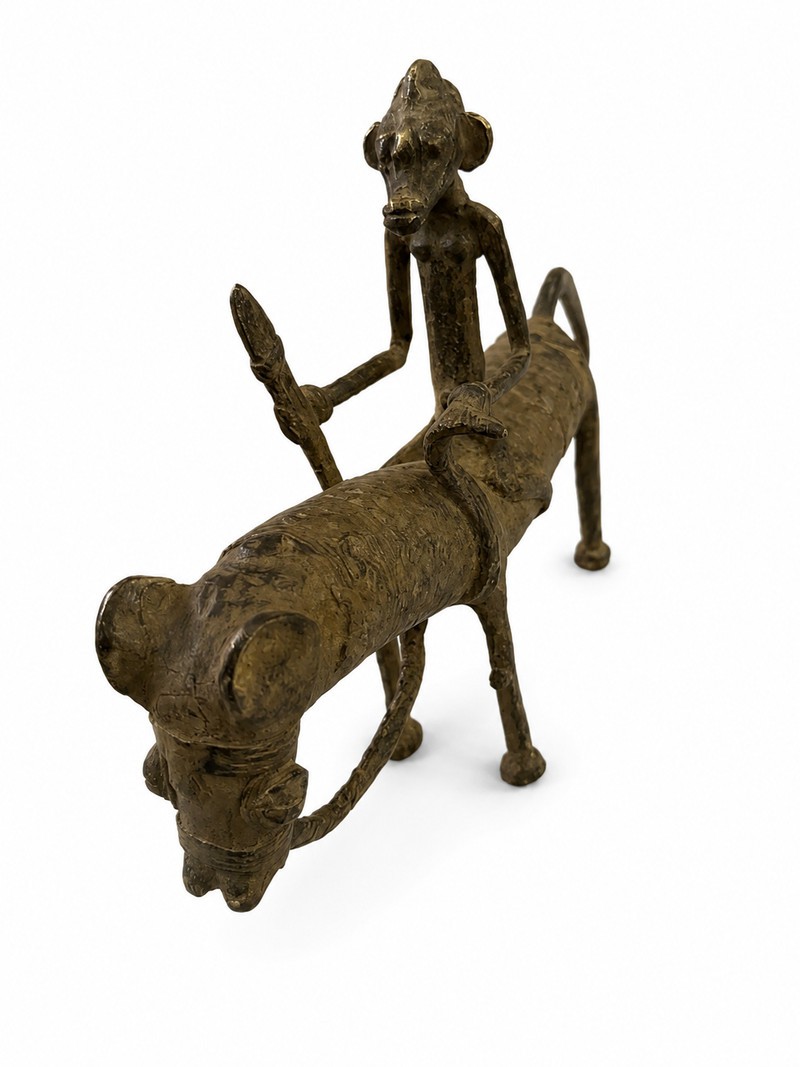
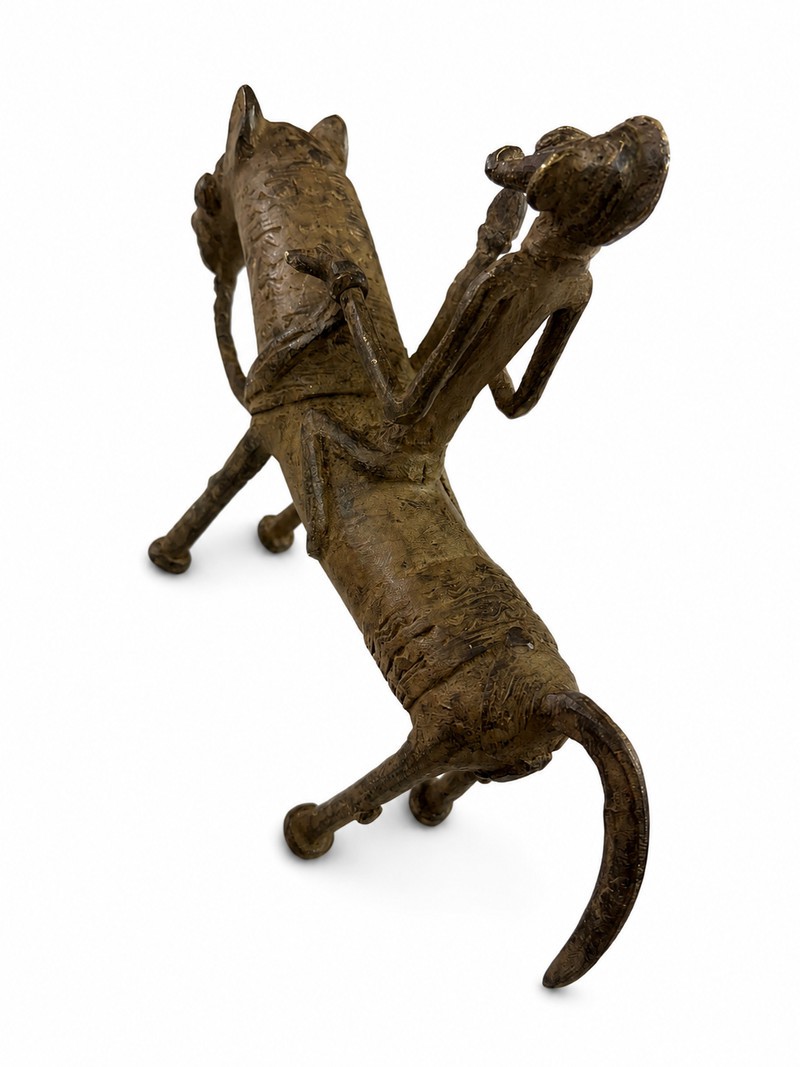
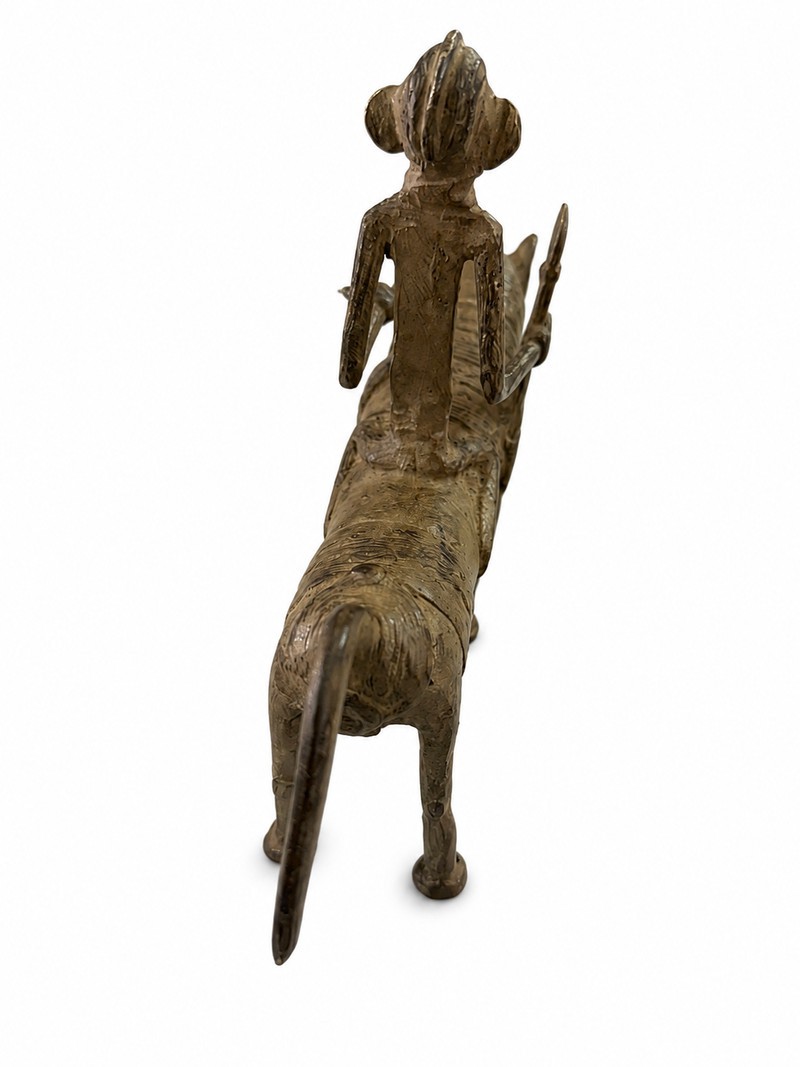
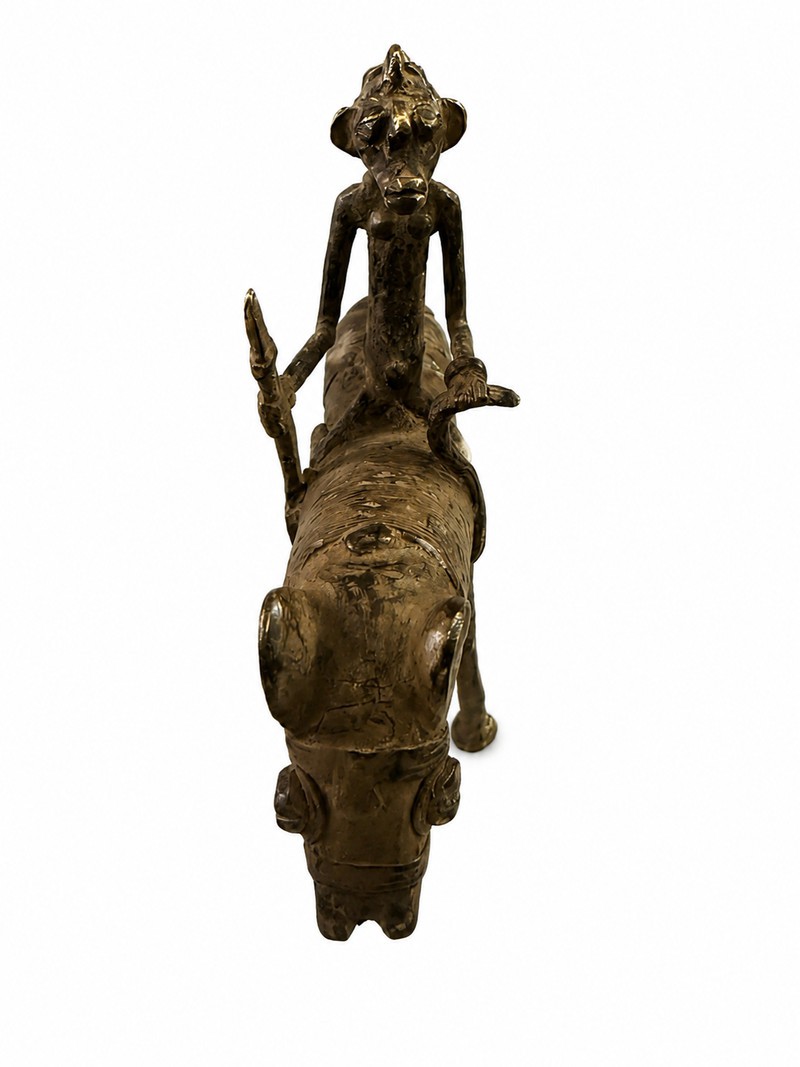
Dogon horseman
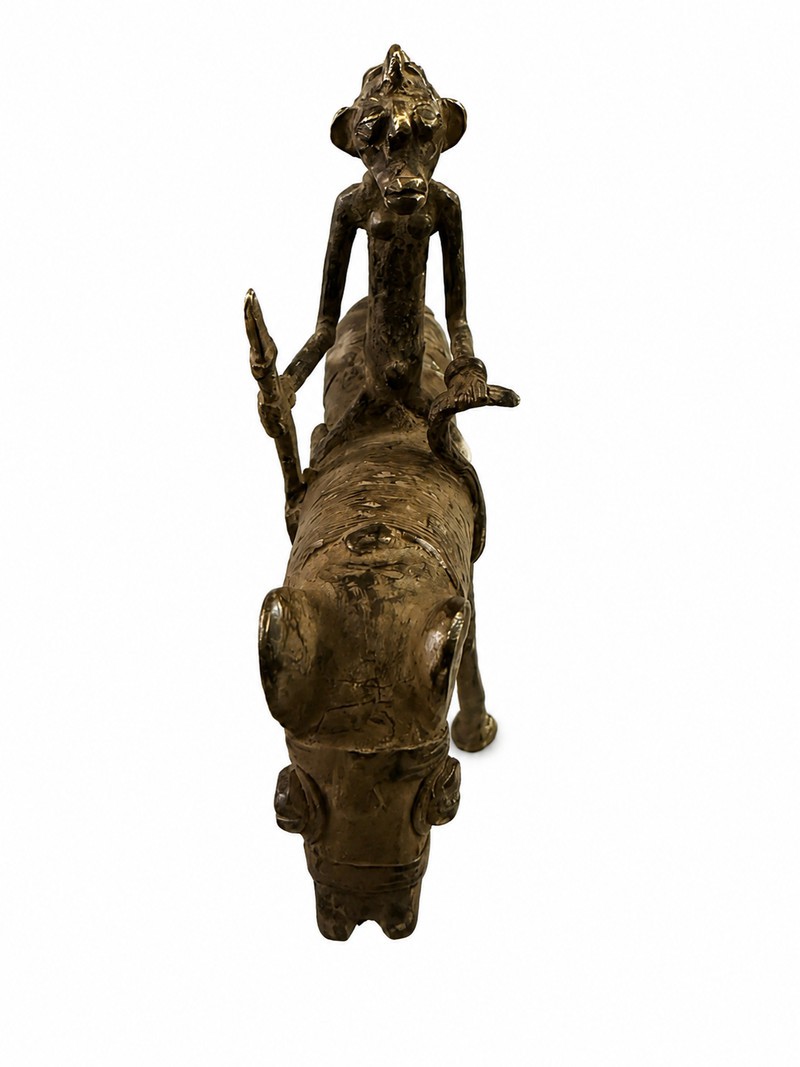
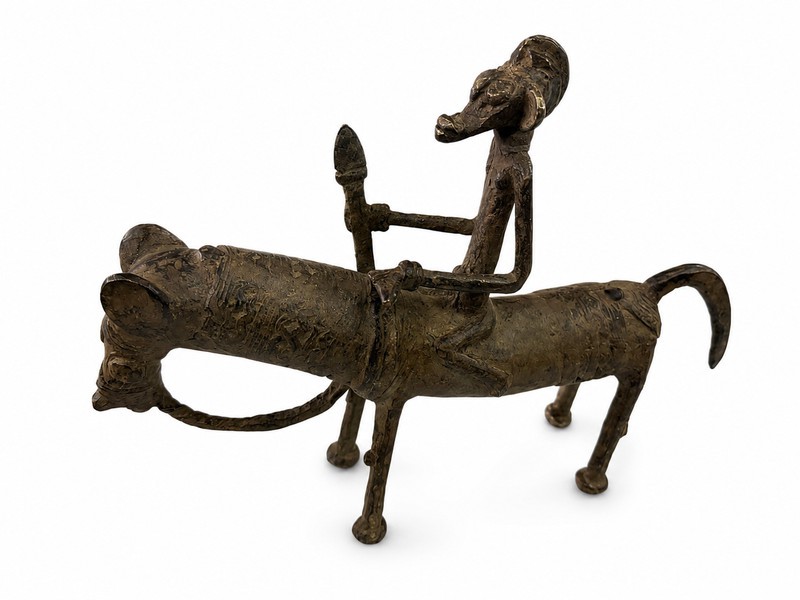
This piece is an ancient traditional sculpture depicting a rider on horseback, typical of the tribal bronze art of the Dogon people in Mali. Origin and symbolism: This object belongs to the traditional statuary of the Dogon ethnic group, where the rider often symbolizes power, ancestral prestige, or spiritual authority. Manufacturing technique: The statuette was handcrafted using the traditional lost-wax casting method, resulting in its characteristic raw and patinated texture. Visual characteristics: The figure features clean, geometric lines, seated on a stylized horse. Cultural significance and Dogon mythology: In the cosmogony and social organization of the Dogon people of Mali, the equestrian figure holds paramount importance on two levels: The Creation Myth (The Nommo): According to mythological accounts, the seventh Nommo (a primordial twin born of the creator god Amma) descended from the heavens to Earth aboard an ark. Upon landing, the ark transformed into a horse. This mythical horseman thus represents the transmitter of civilization, technical know-how (often associated with blacksmiths), and the seeds essential to human survival. Status and Temporal Power (The Hogon): The horse is an animal of luxury and prestige in the arid region of the Bandiagara cliffs. Its possession is reserved for chiefs and the highest spiritual and political authority: the Hogon. Custom dictates that the Hogon must not set foot barefoot on the sacred ground so as not to defile it; the mount therefore symbolizes his ritual purity and power.
Translated automatically
View original
This piece is an ancient traditional sculpture depicting a rider on horseback, typical of the tribal bronze art of the Dogon people in Mali. Origin and symbolism: This object belongs to the traditional statuary of the Dogon ethnic group, where the rider often symbolizes power, ancestral prestige, or spiritual authority. Manufacturing technique: The statuette was handcrafted using the traditional lost-wax casting method, resulting in its characteristic raw and patinated texture. Visual characteristics: The figure features clean, geometric lines, seated on a stylized horse. Cultural significance and Dogon mythology: In the cosmogony and social organization of the Dogon people of Mali, the equestrian figure holds paramount importance on two levels: The Creation Myth (The Nommo): According to mythological accounts, the seventh Nommo (a primordial twin born of the creator god Amma) descended from the heavens to Earth aboard an ark. Upon landing, the ark transformed into a horse. This mythical horseman thus represents the transmitter of civilization, technical know-how (often associated with blacksmiths), and the seeds essential to human survival. Status and Temporal Power (The Hogon): The horse is an animal of luxury and prestige in the arid region of the Bandiagara cliffs. Its possession is reserved for chiefs and the highest spiritual and political authority: the Hogon. Custom dictates that the Hogon must not set foot barefoot on the sacred ground so as not to defile it; the mount therefore symbolizes his ritual purity and power.
Cette pièce est une sculpture traditionnelle ancienne représentant un cavalier sur sa monture, typique de l'art tribal en bronze du peuple Dogon au Mali.
Origine et symbolisme : Cet objet s'inscrit dans la statuaire traditionnelle de l'ethnie Dogon, où le cavalier symbolise souvent la puissance, le prestige des ancêtres ou les autorités spirituelles.
Technique de fabrication : La statuette a été façonnée à la main selon la méthode traditionnelle de la fonte à la cire perdue, ce qui donne cette texture brute et patinée caractéristique.
Caractéristiques visuelles : Le personnage présente des traits épurés et géométriques, assis sur un cheval au corps stylisé.
Signification culturelle et mythologie Dogon
Dans la cosmogonie et l'organisation sociale des Dogons du Mali, la figure équestre revêt une importance primordiale à deux niveaux :
Le Mythe de la Création (Le Nommo) : Selon les récits mythologiques, le septième Nommo (un jumeau primordial né du dieu créateur Amma) est descendu des cieux vers la Terre à bord d'une arche. Lors de son atterrissage, l'arche s'est transformée en cheval.
Ce cavalier mythique représente ainsi le passeur de la civilisation, du savoir-faire technique (souvent associé aux forgerons) et des semences indispensables à la survie humaine.
Le Statut et le Pouvoir Temporel (Le Hogon) : Le cheval est un animal de luxe et de prestige dans la région aride des falaises de Bandiagara. Sa possession est le propre des chefs et de la plus haute autorité spirituelle et politique :
le Hogon. La coutume veut que le Hogon ne doive pas poser le pied nu sur le sol sacré pour ne pas l'altérer ; la monture symbolise donc sa pureté rituelle et son pouvoir.
More from tendancethnik
Visit the shop


You May Also Like
Explore More


Similar searches
At Africa Creates, we do not believe in the myth of predefined sizes. Each body is different and deserves an outfit just as unique. Therefore, to use this guide, we recommend using your measurements in inches (as explained below) rather than the "4 to 22" sizes.
From there you can select the corresponding international size for your order, and each seller will then be able to make sure to send the PERFECT fit for YOU!
How to measure ?
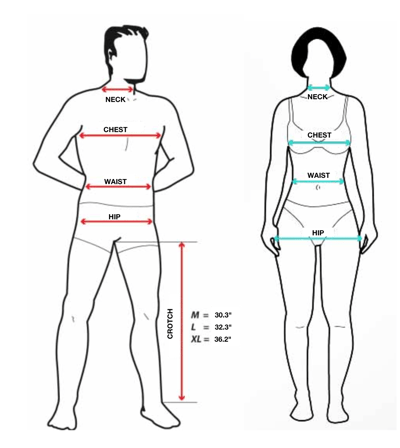
Collar size
Measure around the neck at the neck.
Chest size
Measure around your bust where it is wider by placing the tape measure under the arms and over the shoulder blades.
Waist size
Measure in the hollow of the waist.
Hip size
Keep your feet together and measure the widest part.
Crotch tower
Measure the top of the crotch up to the ankle bone.
Woman - Tops and dresses
| Int | Chest (in) | Waist (in) | Hip (in) | EU | UK | US |
|---|---|---|---|---|---|---|
| XXS | 30.7" - 32.3" | 22.8" - 24.4" | 33.1" - 34.6" | 32 | 4 | 0 |
| XS | 32.3" - 33.9" | 24.4" - 26" | 34.6" - 36.2" | 34 | 6 | 2 |
| S | 33.9" - 35.4" | 26" - 27.6" | 36.2" - 37.8" | 36 | 8 | 4 |
| M | 35.4" - 37" | 27.6" - 29.1" | 37.8" - 39.4" | 38 | 10 | 6 |
| L | 37" - 38.6" | 29.1" - 30.7" | 39.4" - 40.9" | 40 | 12 | 8 |
| XL | 38.6" - 40.2" | 30.7" - 32.3" | 40.9" - 42.5" | 42 | 14 | 10 |
| XXL | 40.2" - 41.7" | 32.3" - 33.9" | 42.5" - 44.1" | 44 | 16 | 12 |
| 3XL | 41.7" - 43.3" | 33.9" - 35.4" | 44.1" - 45.7" | 46 | 18 | 14 |
| 4XL | 43.3" - 45.7" | 35.4" - 38.6" | 45.7" - 48" | 48 | 20 | 16 |
| 5XL | 45.7" - 48" | 38.6" - 41.7" | 48" - 50.4" | 50 | 22 | 18 |
| 6XL | 48" - 50.4" | 41.7" - 44.9" | 50.4" - 52.8" | 52 | 24 | 20 |
| 7XL | 50.4" - 52.8" | 44.9" - 48" | 52.8" - 55.1" | 54 | 26 | 22 |
Woman - Pants, Skirts and Shorts
| Int | Waist (in) | EU | UK | US |
|---|---|---|---|---|
| XXS | 22.8" - 24.4" | 32 | 4 | 0 |
| XS | 24.4" - 26" | 34 | 6 | 2 |
| S | 26" - 27.6" | 36 | 8 | 4 |
| M | 27.6" - 29.1" | 38 | 10 | 6 |
| L | 29.1" - 30.7" | 40 | 12 | 8 |
| XL | 30.7" - 32.3" | 42 | 14 | 10 |
| XXL | 32.3" - 33.9" | 44 | 16 | 12 |
| 3XL | 33.9" - 35.4" | 46 | 18 | 14 |
| 4XL | 35.4" - 38.6" | 48 | 20 | 16 |
| 5XL | 38.6" - 41.7" | 50 | 22 | 18 |
| 6XL | 41.7" - 44.9" | 52 | 24 | 20 |
| 7XL | 44.9" - 48" | 54 | 26 | 22 |
Woman - Swimwear
| Int | Chest (in) | Waist (in) | Hip (in) | EU | UK | US |
|---|---|---|---|---|---|---|
| XXS | 30.7" | 23.6" | 33.1" | 32 | 4 | 0 |
| XS | 31.5" | 24.4" | 33.9" | 34 | 6 | 2 |
| S | 32.7" | 25.6" | 35" | 36 | 8 | 4 |
| M | 34.6" | 27.6" | 37" | 38 | 10 | 6 |
| L | 36.6" | 29.5" | 39" | 40 | 12 | 8 |
| XL | 38.6" | 31.5" | 40.9" | 42 | 14 | 10 |
| XXL | 40.5" | 33.5" | 42.9" | 44 | 16 | 12 |
| 3XL | 43.3" | 36.2" | 45.7" | 46 | 18 | 14 |
Woman - Bra
| Below the breasts (in) | Above the breasts (in) | EU | UK | US |
|---|---|---|---|---|
| 22.8" - 24.4" | 27.6" - 28.3" | 75 (AA) | ||
| 22.8" - 24.4" | 28.3" - 29.1" | 75 (A) | 28A | 28A |
| 22.8" - 24.4" | 29.1" - 29.9" | 75 (B) | 28B | 28B |
| 22.8" - 24.4" | 29.9" - 30.7" | 75 (C) | 28C | 28C |
| 22.8" - 24.4" | 30.7" - 31.5" | 75 (D) | 28D | 28D |
| 22.8" - 24.4" | 31.5" - 32.3" | 75 (E) | 28DD | 28DD |
| 22.8" - 24.4" | 32.3" - 33.1" | 75 (F) | 28E | 28DDD |
| 22.8" - 24.4" | 33" - 33.9" | 75 (G) | 28F | 28G |
| 22.8" - 24.4" | 33.9" - 34.6" | 75 (H) | 28FF | 28H |
| 24.4" - 26.4" | 30.3" - 31.1" | 80 (A) | 30A | 30A |
| 24.4" - 26.4" | 31.1" - 31.9" | 80 (B) | 30B | 30B |
| 24.4" - 26.4" | 31.9" - 32.7" | 80 (C) | 30C | 30C |
| 24.4" - 26.4" | 32.7" - 33.5" | 80 (D) | 30D | 30D |
| 24.4" - 26.4" | 33.5" - 34.2" | 80 (E) | 30DD | 30DD |
| 24.4" - 26.4" | 34.2" - 35" | 80 (F) | 30E | 30DDD |
| 24.4" - 26.4" | 35" - 35.8" | 80 (G) | 30F | 30G |
| 24.4" - 26.4" | 35.8" - 36.6" | 80 (H) | 30FF | 30H |
| 26.4" - 28.3" | 32.3" - 33.1" | 85 (A) | 32A | 32A |
| 26.4" - 28.3" | 33.1" - 33.9" | 85 (B) | 32B | 32B |
| 26.4" - 28.3" | 33.9" - 34.6" | 85 (C) | 32C | 32C |
| 26.4" - 28.3" | 34.6" - 35.4" | 85 (D) | 32D | 32D |
| 26.4" - 28.3" | 35.4" - 36.2" | 85 (E) | 32DD | 32DD |
| 26.4" - 28.3" | 36.2" - 37" | 85 (F) | 32E | 32DDD |
| 26.4" - 28.3" | 37" - 37.8" | 85 (G) | 32F | 32G |
| 26.4" - 28.3" | 37.8" - 38.6" | 85 (H) | 32FF | 32H |
| 28.3" - 30.3" | 34.2" - 35" | 90 (A) | 34A | 34A |
| 28.3" - 30.3" | 35" - 35.8" | 90 (B) | 34B | 34B |
| 28.3" - 30.3" | 35.8" - 36.6" | 90 (C) | 34C | 34C |
| 28.3" - 30.3" | 36.6" - 37.4" | 90 (D) | 34D | 34D |
| 28.3" - 30.3" | 37.4" - 38.2" | 90 (E) | 34DD | 34DD |
| 28.3" - 30.3" | 38.2" - 39" | 90 (F) | 34E | 34DDD |
| 28.3" - 30.3" | 39" - 39.8" | 90 (G) | 34F | 34G |
| 28.3" - 30.3" | 39.8" - 40.5" | 90 (H) | 34FF | 34H |
| 30.3" - 32.3" | 36.2" - 37" | 95 (A) | 36A | 36A |
| 30.3" - 32.3" | 37" - 37.8" | 95 (B) | 36B | 36B |
| 30.3" - 32.3" | 37.8" - 38.6" | 95 (C) | 36C | 36C |
| 30.3" - 32.3" | 38.6" - 39.4" | 95 (D) | 36D | 36D |
| 30.3" - 32.3" | 39.4" - 40.2" | 95 (E) | 36DD | 36DD |
| 30.3" - 32.3" | 40.2" - 40.9" | 95 (F) | 36E | 36DDD |
| 30.3" - 32.3" | 40.9" - 41.7" | 95 (G) | 36F | 36G |
| 30.3" - 32.3" | 41.7" - 42.5" | 95 (H) | 36FF | 36H |
| 100 (AA) | ||||
| 32.3" - 34.2" | 38.2" - 39" | 100 (A) | 38A | 38A |
| 32.3" - 34.2" | 39" - 39.8" | 100 (B) | 38B | 38B |
| 32.3" - 34.2" | 39.8" - 40.5" | 100 (C) | 38C | 38C |
| 32.3" - 34.2" | 40.5" - 41.3" | 100 (D) | 38D | 38D |
| 32.3" - 34.2" | 41.3" - 42.1" | 100 (E) | 38DD | 38DD |
| 32.3" - 34.2" | 42.1" - 42.9" | 100 (F) | 38E | 38DDD |
| 32.3" - 34.2" | 42.9" - 43.7" | 100 (G) | 38F | 38G |
| 32.3" - 34.2" | 43.7" - 44.5" | 100 (H) | 38FF | 38H |
| 34.2" - 36.2" | 40.2" - 40.9" | 105 (A) | 40A | 40A |
| 34.2" - 36.2" | 40.9" - 41.7" | 105 (B) | 40B | 40B |
| 34.2" - 36.2" | 41.7" - 42.5" | 105 (C) | 40C | 40C |
| 34.2" - 36.2" | 42.5" - 43.3" | 105 (D) | 40D | 40D |
| 34.2" - 36.2" | 43.3" - 44.1" | 105 (E) | 40DD | 40DD |
| 34.2" - 36.2" | 44.1" - 44.9" | 105 (F) | 40E | 40DDD |
| 34.2" - 36.2" | 44.9" - 45.7" | 105 (G) | 40F | 40G |
| 34.2" - 36.2" | 45.7" - 46.5" | 105 (H) | 40FF | 40H |
| 36.2" - 38.2" | 42.1" - 42.9" | 110 (A) | 42A | 42A |
| 36.2" - 38.2" | 42.9" - 43.7" | 110 (B) | 42B | 42B |
| 36.2" - 38.2" | 43.7" - 44.5" | 110 (C) | 42C | 42C |
| 36.2" - 38.2" | 44.5" - 45.3" | 110 (D) | 42D | 42D |
| 36.2" - 38.2" | 45.3" - 46.1" | 110 (E) | 42DD | 42DD |
| 36.2" - 38.2" | 46.1" - 46.8" | 110 (F) | 42E | 42DDD |
| 36.2" - 38.2" | 46.8" - 47.6" | 110 (G) | 42F | 42G |
| 36.2" - 38.2" | 47.6" - 48.4" | 110 (H) | 42FF | 42H |
| 38.2" - 40.2" | 44.1" - 44.9" | 115 (A) | 44A | 44A |
| 38.2" - 40.2" | 44.9" - 45.7" | 115 (B) | 44B | 44B |
| 38.2" - 40.2" | 45.7" - 46.5" | 115 (C) | 44C | 44C |
| 38.2" - 40.2" | 46.5" - 47.2" | 115 (D) | 44D | 44D |
| 38.2" - 40.2" | 47.2" - 48" | 115 (E) | 44DD | 44DD |
| 38.2" - 40.2" | 48" - 48.8" | 115 (F) | 44E | 44DDD |
| 38.2" - 40.2" | 48.8" - 49.6" | 115 (G) | 44F | 44G |
| 38.2" - 40.2" | 49.6" - 50.4" | 115 (H) | 44FF | 44H |
Man - Shirts
| Int | Chest (in) | Neckband (in) |
|---|---|---|
| XXS | 32"-34" | 14" |
| XS | 34"-36" | 14.5" |
| S | 36"-38" | 15" |
| M | 38"-40" | 16" |
| L | 40"-42" | 17" |
| XL | 42"-44" | 17.5" |
| XXL | 44"-46" | 18" |
| 3XL | 46"-48" | 18.5" |
Man - T-shirts, polos, sweatshirts and jumpers
| Int | Chest (in) |
|---|---|
| XXS | 32"-34" |
| XS | 34"-36" |
| S | 36"-38" |
| M | 38"-40" |
| L | 40"-42" |
| XL | 42"-44" |
| XXL | 44"-46" |
| 3XL | 46"-48" |
Man - Jackets, parkas and coats
| Int | Chest (in) |
|---|---|
| XXS | 32"-34" |
| XS | 34"-36" |
| S | 36"-38" |
| M | 38"-40" |
| L | 40"-42" |
| XL | 42"-44" |
| XXL | 44"-46" |
| 3XL | 46"-48" |
Man - Pants and shorts
| Int | Waist (in) | Height (in) | Crotch (in) |
|---|---|---|---|
| XXS | 26"-28" | Short | 30" |
| XS | 28"-30" | Standard | 32" |
| S | 30"-32" | Long | 34" |
| M | 32"-34" | ||
| L | 34"-36" | ||
| XL | 36"-38" | ||
| XXL | 38"-40" | ||
| 3XL | 40"-42" | ||
| 4XL | 42"-44" | ||
| 5XL | 44"-46" | ||
| 6XL | 46"-48" |
Kid - Baby
| Age | Weight (kg) | Height (in) |
|---|---|---|
| Birth | 3,3 | 19.7" |
| 1 month | 4 | 21.3" |
| 3 months | 5 - 6 | 23.6" |
| 6 months | 7 - 8 | 26.4" |
| 9 months | 8 - 9 | 27.9" |
| 12 months | 9 - 10 | 29.1" |
| 18 months | 11 | 31.9" |
| 24 months | 12 | 33.9" |
| 36 months | 14 | 37" |
Kid - Girl
| Age | Height (in) | Chest (in) | Waist (in) | Hip (in) |
|---|---|---|---|---|
| 2 years | 32.7" - 34.6" | 20.5" | 18.9" | 22" |
| 3 years | 34.7" - 37.8" | 21.3" | 19.7" | 22.8" |
| 4 years | 37.8" - 40.9" | 22" | 20.5" | 23.6" |
| 5 years | 40.9" - 43.3" | 22.8" | 20.9" | 24.4" |
| 6 years | 43.3" - 45.7" | 23.6" | 21.3" | 26" |
| 7 years | 45.7" - 48" | 24.4" | 21.6" | 26.8" |
| 8 years | 48" - 50.4" | 25.2" | 22" | 27.6" |
| 9 years | 50.4" - 52.8" | 26.4" | 22.4" | 28.7" |
| 10 years | 52.8" - 55.1" | 27.6" | 23.2" | 29.9" |
| 12 years | 55.1" - 59.8" | 30.7" | 24.4" | 33.1" |
| 14 years | 59.8" - 62.2" | 32.3" | 25.2" | 34.6" |
| 16 years | 62.2" - 64.6" | 33.9" | 26" | 36.2" |
Kid - Boy
| Age | Height (in) | Chest (in) | Waist (in) | Hip (in) |
|---|---|---|---|---|
| 2 years | 32.7" - 34.6" | 20.5" | 18.9" | 22" |
| 3 years | 34.6" - 37.8" | 21.3" | 19.7" | 22.8" |
| 4 years | 37.8" - 40.9" | 22" | 20.5" | 23.6" |
| 5 years | 40.9" - 43.3" | 22.8" | 20.9" | 24.4" |
| 6 years | 43.3" - 45.7" | 23.6" | 21.3" | 24.4" |
| 7 years | 45.7" - 48" | 24.4" | 21.6" | 25.2" |
| 8 years | 48" - 50.4" | 25.2" | 22" | 26" |
| 9 years | 50.4" - 52.8" | 26.4" | 22.4" | 27.2" |
| 10 years | 52.8" - 55.1" | 26.8" | 23.2" | 28.3" |
| 12 years | 55.1" - 59.8" | 29.5" | 26" | 30.7" |
| 14 years | 59.8" - 64.6" | 32.3" | 27.6" | 33.9" |
| 16 years | 64.6" - 69.3" | 35" | 29.1" | 36.2" |
Kids - Shoes
| EU | UK | US | in |
|---|---|---|---|
| 16 | 0.5 | 1 | 3.5" |
| 17 | 1 | 1.5 | 3.6" |
| 18 | 2 | 3 | 4" |
| 19 | 3 | 4 | 4.3" |
| 20 | 4 | 5 | 4.6" |
| 21 | 4.5 | 5.5 | 5" |
| 22 | 5 | 6 | 5.2" |
| 23 | 6 | 7 | 5.5" |
| 24 | 7 | 8 | 5.8" |
| 25 | 8 | 9 | 6.1" |
| 26 | 8.5 | 9.5 | 6.3" |
| 27 | 9 | 10 | 6.5" |
| 28 | 10 | 11 | 6.8" |
| 29 | 10.5 | 11.5 | 7" |
| 30 | 11 | 12 | 7.2" |
| 31 | 12 | 13 | 7.5" |
| 32 | 13 | Big Kid 1 | 7.7" |
| 33 | 13.5 | Big Kid 1,5 | 8" |
Woman - Shoes
| EU | UK | US | in |
|---|---|---|---|
| 34 | 2 | 4 | 8.2" |
| 35 | 2.5 | 4.5 | 8.3" |
| 35.5 | 3 | 5 | 8.5" |
| 36 | 3.5 | 5.5 | 8.8" |
| 36.5 | 4 | 6 | 8.9" |
| 37 | 4.5 | 6.5 | 9.1" |
| 37.5 | 5 | 7 | 9.3" |
| 38 | 5.5 | 7.5 | 9.4" |
| 38.5 | 6 | 8 | 9.5" |
| 39 | 6.5 | 8.5 | 9.7" |
| 39.5 | 7 | 9 | 9.9" |
| 40 | 7.5 | 9.5 | 10" |
| 40.5 | 8 | 10 | 10.2" |
| 41 | 8.5 | 10.5 | 10.3" |
| 41.5 | 9 | 11 | 10.5" |
| 42 | 9.5 | 11.5 | 10.7" |
| 42.5 | 10 | 12 | 10.9" |
Man - Shoes
| EU | UK | US | in |
|---|---|---|---|
| 38.5 | 5 | 5.5 | 9" |
| 39 | 5.5 | 6 | 9.3" |
| 39.5 | 6 | 6.5 | 9.5" |
| 40 | 6.5 | 7 | 9.6" |
| 40.5 | 7 | 7.5 | 9.8" |
| 41 | 7.5 | 8 | 9.9" |
| 41.5 | 8 | 8.5 | 10.1" |
| 42 | 8.5 | 9 | 10.3" |
| 42.5 | 9 | 9.5 | 10.4" |
| 43 | 9.5 | 10 | 10.6" |
| 43.5 | 10 | 10.5 | 10.8" |
| 44 | 10.5 | 11 | 10.9" |
| 44.5 | 11 | 11.5 | 11.1" |
| 45 | 11.5 | 12 | 11.3" |
| 46 | 12.5 | 13 | 11.6" |
| 47 | 13.5 | 14 | 11.9" |
| 48 | 14.5 | 15 | 12.2" |