


Dogon horseman
 United States
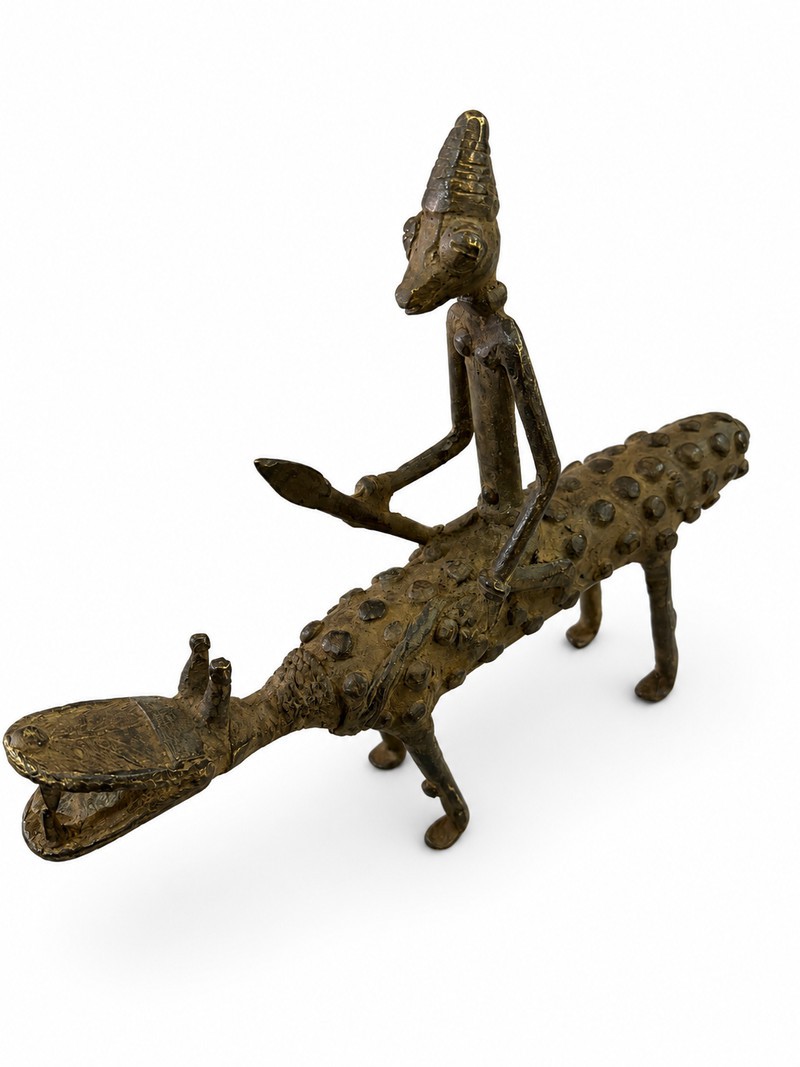
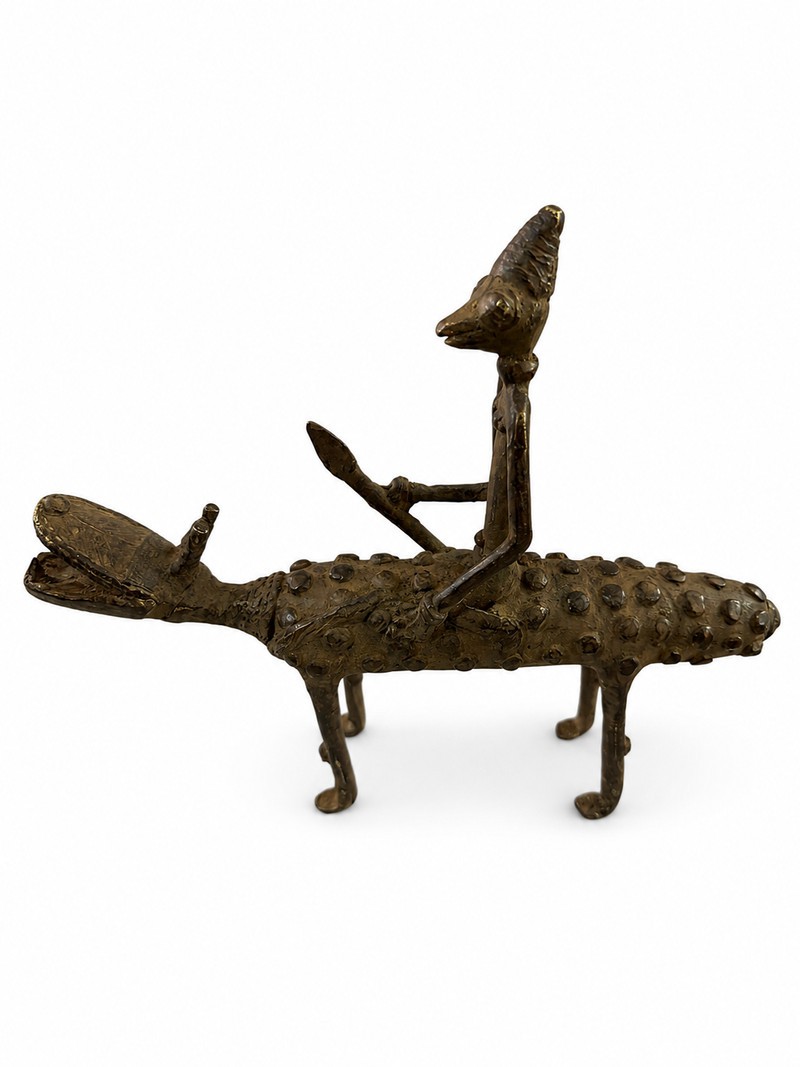
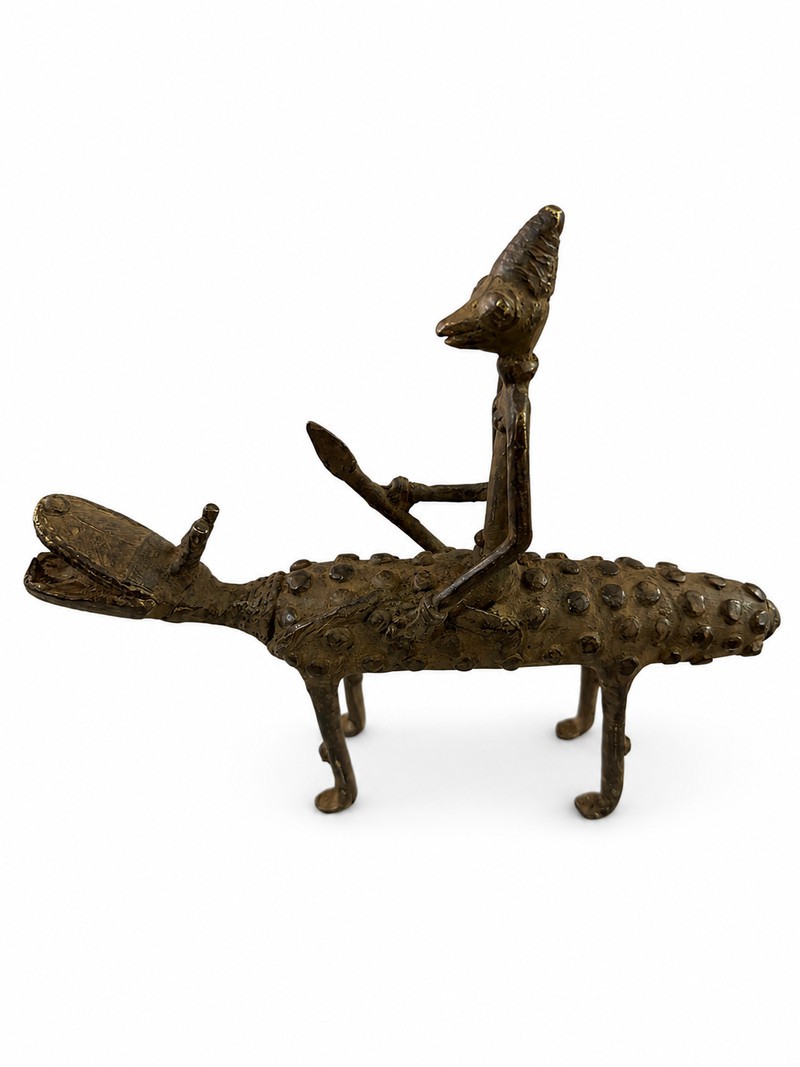
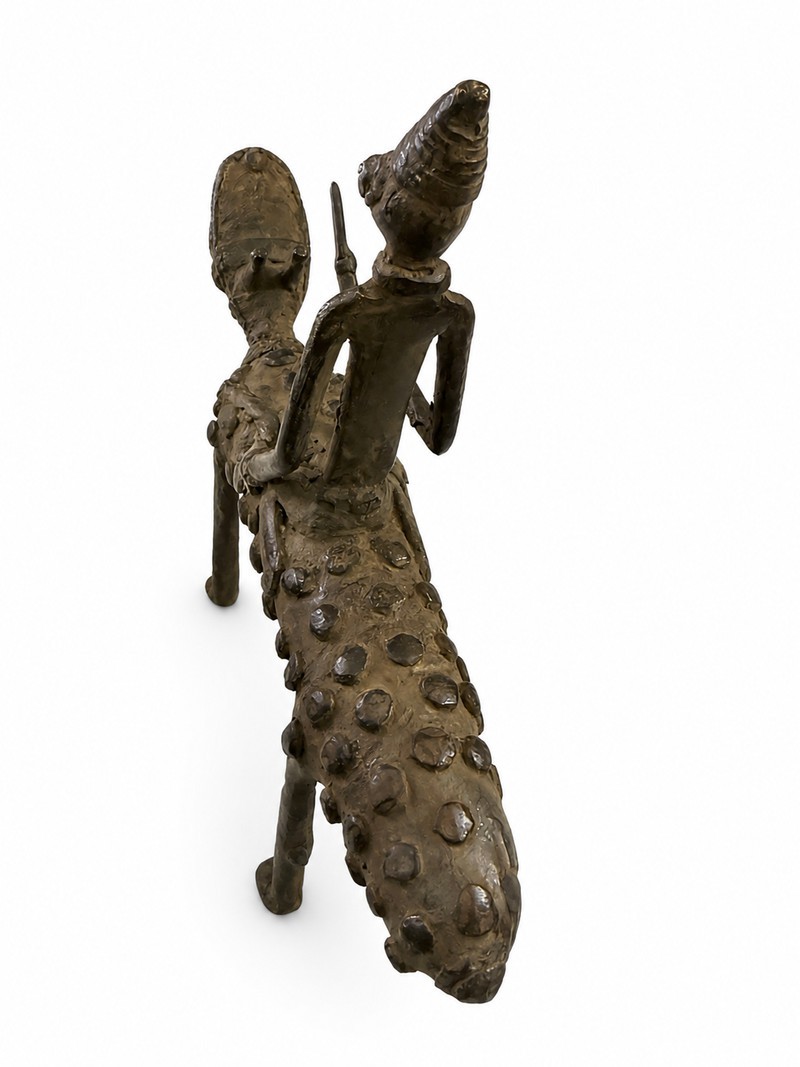
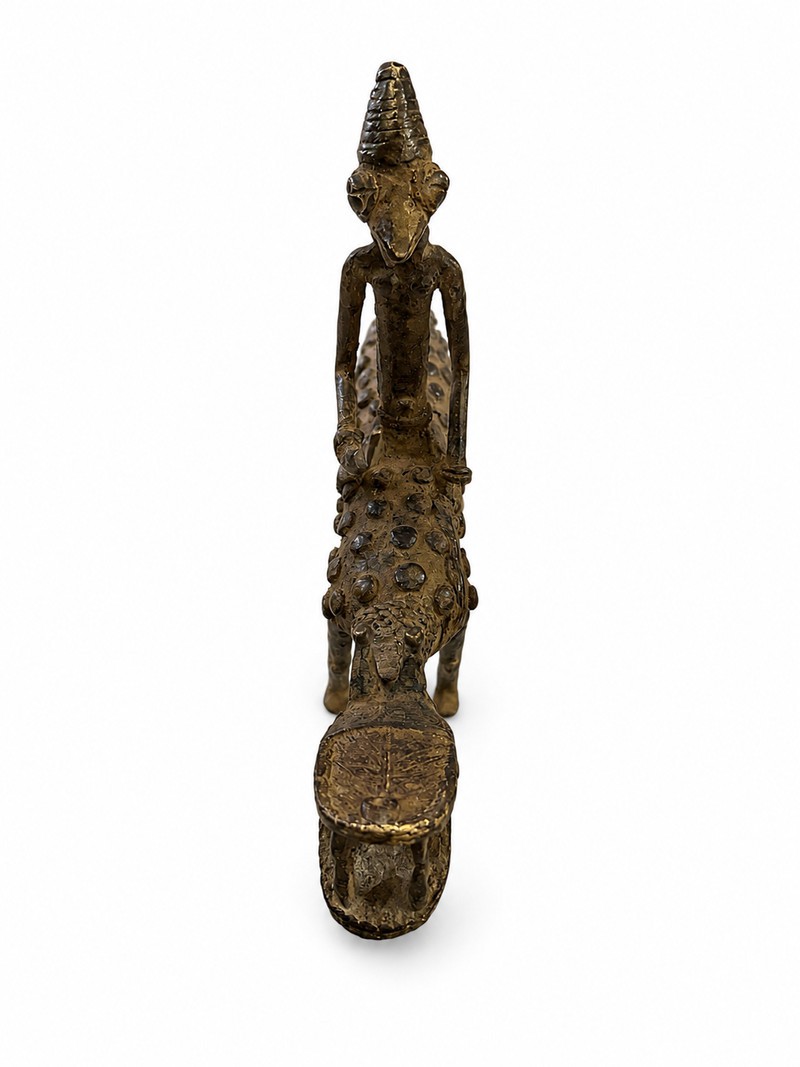
This bronze sculpture depicts a figure riding a crocodile, a major symbolic figure in the art and mythology of the Dogon people of Mali. It differs from the classic horseman in its spiritual significance, directly linked to aquatic environments and the forces of creation. The symbolism of the crocodile among the Dogon: guardian of water: In Dogon cosmology, the crocodile (Ogo) plays a fundamental protective role. An amphibious animal, it ensures the link between the terrestrial and aquatic worlds, the latter being the domain of Nommo, the ancestral spirit of water and fertility. The mythological ally: According to traditional accounts, the crocodile is the animal that guided or transported the founding ancestors of the Dogon people across waterways (notably the Niger River) to the safety of the Bandiagara cliffs. It is considered a protective totem ancestor who must not be harmed. The representation of power: The figure seated on the reptile's back (often associated with a spiritual leader or healer) demonstrates their mastery of the hidden forces of nature and water. The spear or staff they hold affirms this status of authority and protection. Manufacturing and stylistic characteristics: The lost-wax casting technique: This piece was cast as a unique example by a blacksmith. The clay mold that had encased the original wax form was broken to release the bronze after casting. The textured finish: The crocodile's body is entirely covered with small protrusions or raised dots to stylize its rough scales. The animal's head is depicted with its mouth slightly open, a classic feature of this type of statuary. The brown patina: The oxidation of the copper alloy gives it a matte, earthy appearance, typical of objects kept in homes or placed on family and communal altars.
Translated automatically
View original
This bronze sculpture depicts a figure riding a crocodile, a major symbolic figure in the art and mythology of the Dogon people of Mali. It differs from the classic horseman in its spiritual significance, directly linked to aquatic environments and the forces of creation. The symbolism of the crocodile among the Dogon: guardian of water: In Dogon cosmology, the crocodile (Ogo) plays a fundamental protective role. An amphibious animal, it ensures the link between the terrestrial and aquatic worlds, the latter being the domain of Nommo, the ancestral spirit of water and fertility. The mythological ally: According to traditional accounts, the crocodile is the animal that guided or transported the founding ancestors of the Dogon people across waterways (notably the Niger River) to the safety of the Bandiagara cliffs. It is considered a protective totem ancestor who must not be harmed. The representation of power: The figure seated on the reptile's back (often associated with a spiritual leader or healer) demonstrates their mastery of the hidden forces of nature and water. The spear or staff they hold affirms this status of authority and protection. Manufacturing and stylistic characteristics: The lost-wax casting technique: This piece was cast as a unique example by a blacksmith. The clay mold that had encased the original wax form was broken to release the bronze after casting. The textured finish: The crocodile's body is entirely covered with small protrusions or raised dots to stylize its rough scales. The animal's head is depicted with its mouth slightly open, a classic feature of this type of statuary. The brown patina: The oxidation of the copper alloy gives it a matte, earthy appearance, typical of objects kept in homes or placed on family and communal altars.
Cette sculpture en bronze représente un personnage chevauchant un crocodile, une figure symbolique majeure de l'art et de la mythologie du peuple Dogon du Mali. Elle se distingue du cavalier classique sur son cheval par une portée spirituelle liée directement aux milieux aquatiques et aux forces de la création.
Le symbolisme du crocodile chez les Dogon le gardien de l'eau : Dans la cosmogonie Dogon, le crocodile (Ogo) joue un rôle protecteur fondamental.
Animal amphibie, il assure le lien entre le monde terrestre et le monde aquatique, ce dernier étant le domaine du Nommo, l'esprit ancestral de l'eau et de la fertilité.
L'allié mythologique : Selon les récits traditionnels, le crocodile est l'animal qui a guidé ou transporté les ancêtres fondateurs du peuple Dogon à travers les cours d'eau (notamment le fleuve Niger) pour les mener à l'abri vers les falaises de Bandiagara. Il est considéré comme un ancêtre totem protecteur auquel on ne doit pas faire de mal.
La figuration du pouvoir : Le personnage assis sur le dos du reptile (souvent assimilé à un chef spirituel ou un guérisseur) montre sa maîtrise des forces cachées de la nature et de l'eau. La lance ou le bâton qu'il tient affirme ce statut d'autorité et de protection.
Caractéristiques de fabrication et de styleLa technique de la cire perdue : cette pièce a été coulée en exemplaire unique par un forgeron. Le moule en argile ayant enveloppé la forme en cire d'origine a été brisé pour libérer le bronze après la coulée.
Le rendu texturé : Le corps du crocodile est entièrement recouvert de petites protubérances ou pastilles en saillie pour imiter de manière stylisée ses écailles rugueuses.
La tête de l'animal est représentée la gueule entrouverte, un trait classique de cette statuaire.
La patine brune : L'oxydation de l'alliage cuivreux présente un aspect mat et terreux, typique des objets conservés dans des habitations ou placés sur des autels familiaux et collectifs.
More from tendancethnik 

Visit the shop


You May Also Like
Explore More


Similar searches
At Africa Creates, we do not believe in the myth of predefined sizes. Each body is different and deserves an outfit just as unique. Therefore, to use this guide, we recommend using your measurements in inches (as explained below) rather than the "4 to 22" sizes.
From there you can select the corresponding international size for your order, and each seller will then be able to make sure to send the PERFECT fit for YOU!
How to measure ?
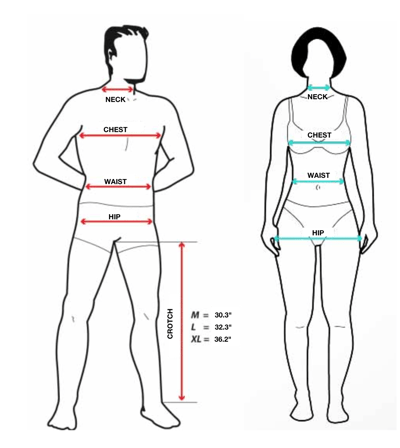
Collar size
Measure around the neck at the neck.
Chest size
Measure around your bust where it is wider by placing the tape measure under the arms and over the shoulder blades.
Waist size
Measure in the hollow of the waist.
Hip size
Keep your feet together and measure the widest part.
Crotch tower
Measure the top of the crotch up to the ankle bone.
Woman - Tops and dresses
| Int | Chest (in) | Waist (in) | Hip (in) | EU | UK | US |
|---|---|---|---|---|---|---|
| XXS | 30.7" - 32.3" | 22.8" - 24.4" | 33.1" - 34.6" | 32 | 4 | 0 |
| XS | 32.3" - 33.9" | 24.4" - 26" | 34.6" - 36.2" | 34 | 6 | 2 |
| S | 33.9" - 35.4" | 26" - 27.6" | 36.2" - 37.8" | 36 | 8 | 4 |
| M | 35.4" - 37" | 27.6" - 29.1" | 37.8" - 39.4" | 38 | 10 | 6 |
| L | 37" - 38.6" | 29.1" - 30.7" | 39.4" - 40.9" | 40 | 12 | 8 |
| XL | 38.6" - 40.2" | 30.7" - 32.3" | 40.9" - 42.5" | 42 | 14 | 10 |
| XXL | 40.2" - 41.7" | 32.3" - 33.9" | 42.5" - 44.1" | 44 | 16 | 12 |
| 3XL | 41.7" - 43.3" | 33.9" - 35.4" | 44.1" - 45.7" | 46 | 18 | 14 |
| 4XL | 43.3" - 45.7" | 35.4" - 38.6" | 45.7" - 48" | 48 | 20 | 16 |
| 5XL | 45.7" - 48" | 38.6" - 41.7" | 48" - 50.4" | 50 | 22 | 18 |
| 6XL | 48" - 50.4" | 41.7" - 44.9" | 50.4" - 52.8" | 52 | 24 | 20 |
| 7XL | 50.4" - 52.8" | 44.9" - 48" | 52.8" - 55.1" | 54 | 26 | 22 |
Woman - Pants, Skirts and Shorts
| Int | Waist (in) | EU | UK | US |
|---|---|---|---|---|
| XXS | 22.8" - 24.4" | 32 | 4 | 0 |
| XS | 24.4" - 26" | 34 | 6 | 2 |
| S | 26" - 27.6" | 36 | 8 | 4 |
| M | 27.6" - 29.1" | 38 | 10 | 6 |
| L | 29.1" - 30.7" | 40 | 12 | 8 |
| XL | 30.7" - 32.3" | 42 | 14 | 10 |
| XXL | 32.3" - 33.9" | 44 | 16 | 12 |
| 3XL | 33.9" - 35.4" | 46 | 18 | 14 |
| 4XL | 35.4" - 38.6" | 48 | 20 | 16 |
| 5XL | 38.6" - 41.7" | 50 | 22 | 18 |
| 6XL | 41.7" - 44.9" | 52 | 24 | 20 |
| 7XL | 44.9" - 48" | 54 | 26 | 22 |
Woman - Swimwear
| Int | Chest (in) | Waist (in) | Hip (in) | EU | UK | US |
|---|---|---|---|---|---|---|
| XXS | 30.7" | 23.6" | 33.1" | 32 | 4 | 0 |
| XS | 31.5" | 24.4" | 33.9" | 34 | 6 | 2 |
| S | 32.7" | 25.6" | 35" | 36 | 8 | 4 |
| M | 34.6" | 27.6" | 37" | 38 | 10 | 6 |
| L | 36.6" | 29.5" | 39" | 40 | 12 | 8 |
| XL | 38.6" | 31.5" | 40.9" | 42 | 14 | 10 |
| XXL | 40.5" | 33.5" | 42.9" | 44 | 16 | 12 |
| 3XL | 43.3" | 36.2" | 45.7" | 46 | 18 | 14 |
Woman - Bra
| Below the breasts (in) | Above the breasts (in) | EU | UK | US |
|---|---|---|---|---|
| 22.8" - 24.4" | 27.6" - 28.3" | 75 (AA) | ||
| 22.8" - 24.4" | 28.3" - 29.1" | 75 (A) | 28A | 28A |
| 22.8" - 24.4" | 29.1" - 29.9" | 75 (B) | 28B | 28B |
| 22.8" - 24.4" | 29.9" - 30.7" | 75 (C) | 28C | 28C |
| 22.8" - 24.4" | 30.7" - 31.5" | 75 (D) | 28D | 28D |
| 22.8" - 24.4" | 31.5" - 32.3" | 75 (E) | 28DD | 28DD |
| 22.8" - 24.4" | 32.3" - 33.1" | 75 (F) | 28E | 28DDD |
| 22.8" - 24.4" | 33" - 33.9" | 75 (G) | 28F | 28G |
| 22.8" - 24.4" | 33.9" - 34.6" | 75 (H) | 28FF | 28H |
| 24.4" - 26.4" | 30.3" - 31.1" | 80 (A) | 30A | 30A |
| 24.4" - 26.4" | 31.1" - 31.9" | 80 (B) | 30B | 30B |
| 24.4" - 26.4" | 31.9" - 32.7" | 80 (C) | 30C | 30C |
| 24.4" - 26.4" | 32.7" - 33.5" | 80 (D) | 30D | 30D |
| 24.4" - 26.4" | 33.5" - 34.2" | 80 (E) | 30DD | 30DD |
| 24.4" - 26.4" | 34.2" - 35" | 80 (F) | 30E | 30DDD |
| 24.4" - 26.4" | 35" - 35.8" | 80 (G) | 30F | 30G |
| 24.4" - 26.4" | 35.8" - 36.6" | 80 (H) | 30FF | 30H |
| 26.4" - 28.3" | 32.3" - 33.1" | 85 (A) | 32A | 32A |
| 26.4" - 28.3" | 33.1" - 33.9" | 85 (B) | 32B | 32B |
| 26.4" - 28.3" | 33.9" - 34.6" | 85 (C) | 32C | 32C |
| 26.4" - 28.3" | 34.6" - 35.4" | 85 (D) | 32D | 32D |
| 26.4" - 28.3" | 35.4" - 36.2" | 85 (E) | 32DD | 32DD |
| 26.4" - 28.3" | 36.2" - 37" | 85 (F) | 32E | 32DDD |
| 26.4" - 28.3" | 37" - 37.8" | 85 (G) | 32F | 32G |
| 26.4" - 28.3" | 37.8" - 38.6" | 85 (H) | 32FF | 32H |
| 28.3" - 30.3" | 34.2" - 35" | 90 (A) | 34A | 34A |
| 28.3" - 30.3" | 35" - 35.8" | 90 (B) | 34B | 34B |
| 28.3" - 30.3" | 35.8" - 36.6" | 90 (C) | 34C | 34C |
| 28.3" - 30.3" | 36.6" - 37.4" | 90 (D) | 34D | 34D |
| 28.3" - 30.3" | 37.4" - 38.2" | 90 (E) | 34DD | 34DD |
| 28.3" - 30.3" | 38.2" - 39" | 90 (F) | 34E | 34DDD |
| 28.3" - 30.3" | 39" - 39.8" | 90 (G) | 34F | 34G |
| 28.3" - 30.3" | 39.8" - 40.5" | 90 (H) | 34FF | 34H |
| 30.3" - 32.3" | 36.2" - 37" | 95 (A) | 36A | 36A |
| 30.3" - 32.3" | 37" - 37.8" | 95 (B) | 36B | 36B |
| 30.3" - 32.3" | 37.8" - 38.6" | 95 (C) | 36C | 36C |
| 30.3" - 32.3" | 38.6" - 39.4" | 95 (D) | 36D | 36D |
| 30.3" - 32.3" | 39.4" - 40.2" | 95 (E) | 36DD | 36DD |
| 30.3" - 32.3" | 40.2" - 40.9" | 95 (F) | 36E | 36DDD |
| 30.3" - 32.3" | 40.9" - 41.7" | 95 (G) | 36F | 36G |
| 30.3" - 32.3" | 41.7" - 42.5" | 95 (H) | 36FF | 36H |
| 100 (AA) | ||||
| 32.3" - 34.2" | 38.2" - 39" | 100 (A) | 38A | 38A |
| 32.3" - 34.2" | 39" - 39.8" | 100 (B) | 38B | 38B |
| 32.3" - 34.2" | 39.8" - 40.5" | 100 (C) | 38C | 38C |
| 32.3" - 34.2" | 40.5" - 41.3" | 100 (D) | 38D | 38D |
| 32.3" - 34.2" | 41.3" - 42.1" | 100 (E) | 38DD | 38DD |
| 32.3" - 34.2" | 42.1" - 42.9" | 100 (F) | 38E | 38DDD |
| 32.3" - 34.2" | 42.9" - 43.7" | 100 (G) | 38F | 38G |
| 32.3" - 34.2" | 43.7" - 44.5" | 100 (H) | 38FF | 38H |
| 34.2" - 36.2" | 40.2" - 40.9" | 105 (A) | 40A | 40A |
| 34.2" - 36.2" | 40.9" - 41.7" | 105 (B) | 40B | 40B |
| 34.2" - 36.2" | 41.7" - 42.5" | 105 (C) | 40C | 40C |
| 34.2" - 36.2" | 42.5" - 43.3" | 105 (D) | 40D | 40D |
| 34.2" - 36.2" | 43.3" - 44.1" | 105 (E) | 40DD | 40DD |
| 34.2" - 36.2" | 44.1" - 44.9" | 105 (F) | 40E | 40DDD |
| 34.2" - 36.2" | 44.9" - 45.7" | 105 (G) | 40F | 40G |
| 34.2" - 36.2" | 45.7" - 46.5" | 105 (H) | 40FF | 40H |
| 36.2" - 38.2" | 42.1" - 42.9" | 110 (A) | 42A | 42A |
| 36.2" - 38.2" | 42.9" - 43.7" | 110 (B) | 42B | 42B |
| 36.2" - 38.2" | 43.7" - 44.5" | 110 (C) | 42C | 42C |
| 36.2" - 38.2" | 44.5" - 45.3" | 110 (D) | 42D | 42D |
| 36.2" - 38.2" | 45.3" - 46.1" | 110 (E) | 42DD | 42DD |
| 36.2" - 38.2" | 46.1" - 46.8" | 110 (F) | 42E | 42DDD |
| 36.2" - 38.2" | 46.8" - 47.6" | 110 (G) | 42F | 42G |
| 36.2" - 38.2" | 47.6" - 48.4" | 110 (H) | 42FF | 42H |
| 38.2" - 40.2" | 44.1" - 44.9" | 115 (A) | 44A | 44A |
| 38.2" - 40.2" | 44.9" - 45.7" | 115 (B) | 44B | 44B |
| 38.2" - 40.2" | 45.7" - 46.5" | 115 (C) | 44C | 44C |
| 38.2" - 40.2" | 46.5" - 47.2" | 115 (D) | 44D | 44D |
| 38.2" - 40.2" | 47.2" - 48" | 115 (E) | 44DD | 44DD |
| 38.2" - 40.2" | 48" - 48.8" | 115 (F) | 44E | 44DDD |
| 38.2" - 40.2" | 48.8" - 49.6" | 115 (G) | 44F | 44G |
| 38.2" - 40.2" | 49.6" - 50.4" | 115 (H) | 44FF | 44H |
Man - Shirts
| Int | Chest (in) | Neckband (in) |
|---|---|---|
| XXS | 32"-34" | 14" |
| XS | 34"-36" | 14.5" |
| S | 36"-38" | 15" |
| M | 38"-40" | 16" |
| L | 40"-42" | 17" |
| XL | 42"-44" | 17.5" |
| XXL | 44"-46" | 18" |
| 3XL | 46"-48" | 18.5" |
Man - T-shirts, polos, sweatshirts and jumpers
| Int | Chest (in) |
|---|---|
| XXS | 32"-34" |
| XS | 34"-36" |
| S | 36"-38" |
| M | 38"-40" |
| L | 40"-42" |
| XL | 42"-44" |
| XXL | 44"-46" |
| 3XL | 46"-48" |
Man - Jackets, parkas and coats
| Int | Chest (in) |
|---|---|
| XXS | 32"-34" |
| XS | 34"-36" |
| S | 36"-38" |
| M | 38"-40" |
| L | 40"-42" |
| XL | 42"-44" |
| XXL | 44"-46" |
| 3XL | 46"-48" |
Man - Pants and shorts
| Int | Waist (in) | Height (in) | Crotch (in) |
|---|---|---|---|
| XXS | 26"-28" | Short | 30" |
| XS | 28"-30" | Standard | 32" |
| S | 30"-32" | Long | 34" |
| M | 32"-34" | ||
| L | 34"-36" | ||
| XL | 36"-38" | ||
| XXL | 38"-40" | ||
| 3XL | 40"-42" | ||
| 4XL | 42"-44" | ||
| 5XL | 44"-46" | ||
| 6XL | 46"-48" |
Kid - Baby
| Age | Weight (kg) | Height (in) |
|---|---|---|
| Birth | 3,3 | 19.7" |
| 1 month | 4 | 21.3" |
| 3 months | 5 - 6 | 23.6" |
| 6 months | 7 - 8 | 26.4" |
| 9 months | 8 - 9 | 27.9" |
| 12 months | 9 - 10 | 29.1" |
| 18 months | 11 | 31.9" |
| 24 months | 12 | 33.9" |
| 36 months | 14 | 37" |
Kid - Girl
| Age | Height (in) | Chest (in) | Waist (in) | Hip (in) |
|---|---|---|---|---|
| 2 years | 32.7" - 34.6" | 20.5" | 18.9" | 22" |
| 3 years | 34.7" - 37.8" | 21.3" | 19.7" | 22.8" |
| 4 years | 37.8" - 40.9" | 22" | 20.5" | 23.6" |
| 5 years | 40.9" - 43.3" | 22.8" | 20.9" | 24.4" |
| 6 years | 43.3" - 45.7" | 23.6" | 21.3" | 26" |
| 7 years | 45.7" - 48" | 24.4" | 21.6" | 26.8" |
| 8 years | 48" - 50.4" | 25.2" | 22" | 27.6" |
| 9 years | 50.4" - 52.8" | 26.4" | 22.4" | 28.7" |
| 10 years | 52.8" - 55.1" | 27.6" | 23.2" | 29.9" |
| 12 years | 55.1" - 59.8" | 30.7" | 24.4" | 33.1" |
| 14 years | 59.8" - 62.2" | 32.3" | 25.2" | 34.6" |
| 16 years | 62.2" - 64.6" | 33.9" | 26" | 36.2" |
Kid - Boy
| Age | Height (in) | Chest (in) | Waist (in) | Hip (in) |
|---|---|---|---|---|
| 2 years | 32.7" - 34.6" | 20.5" | 18.9" | 22" |
| 3 years | 34.6" - 37.8" | 21.3" | 19.7" | 22.8" |
| 4 years | 37.8" - 40.9" | 22" | 20.5" | 23.6" |
| 5 years | 40.9" - 43.3" | 22.8" | 20.9" | 24.4" |
| 6 years | 43.3" - 45.7" | 23.6" | 21.3" | 24.4" |
| 7 years | 45.7" - 48" | 24.4" | 21.6" | 25.2" |
| 8 years | 48" - 50.4" | 25.2" | 22" | 26" |
| 9 years | 50.4" - 52.8" | 26.4" | 22.4" | 27.2" |
| 10 years | 52.8" - 55.1" | 26.8" | 23.2" | 28.3" |
| 12 years | 55.1" - 59.8" | 29.5" | 26" | 30.7" |
| 14 years | 59.8" - 64.6" | 32.3" | 27.6" | 33.9" |
| 16 years | 64.6" - 69.3" | 35" | 29.1" | 36.2" |
Kids - Shoes
| EU | UK | US | in |
|---|---|---|---|
| 16 | 0.5 | 1 | 3.5" |
| 17 | 1 | 1.5 | 3.6" |
| 18 | 2 | 3 | 4" |
| 19 | 3 | 4 | 4.3" |
| 20 | 4 | 5 | 4.6" |
| 21 | 4.5 | 5.5 | 5" |
| 22 | 5 | 6 | 5.2" |
| 23 | 6 | 7 | 5.5" |
| 24 | 7 | 8 | 5.8" |
| 25 | 8 | 9 | 6.1" |
| 26 | 8.5 | 9.5 | 6.3" |
| 27 | 9 | 10 | 6.5" |
| 28 | 10 | 11 | 6.8" |
| 29 | 10.5 | 11.5 | 7" |
| 30 | 11 | 12 | 7.2" |
| 31 | 12 | 13 | 7.5" |
| 32 | 13 | Big Kid 1 | 7.7" |
| 33 | 13.5 | Big Kid 1,5 | 8" |
Woman - Shoes
| EU | UK | US | in |
|---|---|---|---|
| 34 | 2 | 4 | 8.2" |
| 35 | 2.5 | 4.5 | 8.3" |
| 35.5 | 3 | 5 | 8.5" |
| 36 | 3.5 | 5.5 | 8.8" |
| 36.5 | 4 | 6 | 8.9" |
| 37 | 4.5 | 6.5 | 9.1" |
| 37.5 | 5 | 7 | 9.3" |
| 38 | 5.5 | 7.5 | 9.4" |
| 38.5 | 6 | 8 | 9.5" |
| 39 | 6.5 | 8.5 | 9.7" |
| 39.5 | 7 | 9 | 9.9" |
| 40 | 7.5 | 9.5 | 10" |
| 40.5 | 8 | 10 | 10.2" |
| 41 | 8.5 | 10.5 | 10.3" |
| 41.5 | 9 | 11 | 10.5" |
| 42 | 9.5 | 11.5 | 10.7" |
| 42.5 | 10 | 12 | 10.9" |
Man - Shoes
| EU | UK | US | in |
|---|---|---|---|
| 38.5 | 5 | 5.5 | 9" |
| 39 | 5.5 | 6 | 9.3" |
| 39.5 | 6 | 6.5 | 9.5" |
| 40 | 6.5 | 7 | 9.6" |
| 40.5 | 7 | 7.5 | 9.8" |
| 41 | 7.5 | 8 | 9.9" |
| 41.5 | 8 | 8.5 | 10.1" |
| 42 | 8.5 | 9 | 10.3" |
| 42.5 | 9 | 9.5 | 10.4" |
| 43 | 9.5 | 10 | 10.6" |
| 43.5 | 10 | 10.5 | 10.8" |
| 44 | 10.5 | 11 | 10.9" |
| 44.5 | 11 | 11.5 | 11.1" |
| 45 | 11.5 | 12 | 11.3" |
| 46 | 12.5 | 13 | 11.6" |
| 47 | 13.5 | 14 | 11.9" |
| 48 | 14.5 | 15 | 12.2" |